Pericles, Prince of Tyre, sort of by William Shakespeare, at Theatre for a New Audience (“TFANA”), Polonsky
Shakespeare Center
I
haven’t seen Pericles, Prince of Tyre in decades, and when I saw the Michael
Greif production downtown at the Public in the nineties, I enjoyed it as a lark. Perhaps because of the old-fashioned theatrical
effects they used, like a rumbling sheet of metal for thunder…ah the good old
days.
This
time around it’s directed by Trevor
Nunn, whose credentials are pretty darned good. And yet…. perhaps too good. Pericles must
surely be Shakespeare’s oddest and even most doubtful play. Certainly it’s doubtful that Shakespeare had
a hand in the first “half.” Occasionally
the verse sounds like Shakespeare — the second half of the play, for instance,
flows much better than the first. The
first, however, is rather like a jiggly early black-and-white film being rolled
manually. It moves in starts and stops,
so the story jumps and starts as well.
Don’t
get me wrong. This production
has quite a few good points. I’m guessing that the
play’s the thing that gets my goat. It
has old stories linked together only by Pericles, with no call to think the
stories are from the same eon. Most
importantly, if I captained or owned a ship and I saw Pericles coming, I’d ban
him from my boat. The man is bad luck.
The
focus of the stark set was a striking bronze disk at the back of the
stage. While it reminded us of the
poorly used bright disk used to blind the audience in last year’s Antigone [http://www.mollyismusing.blogspot.com/search/label/Antigone]
at BAM, this one was used to much better effect. The bronze disk looked battered, then
patterned, then glowed around the edges, then opened at center, sometimes into
a doorway, large or small, sometimes to appear a porthole to view the play’s storms
at sea. All sorts of worlds and images
live behind the bronze disc, including one that allows old Gower the
storyteller to materialize, seemingly a ghost in another dimension, by stepping
into our dimension and onto the stage. Raphael
Nash Thompson’s practiced voice booms out telling the tale from days gone
by, an old tale, of Prince Pericles.
Often he sings it — there’s a lot of singing in this production, and it
is very fine. Gower is amused and
amusing although at times pushing the lesser language a bit too hard.
The
next to enter the thrust stage is Pericles, Prince of Tyre, as depicted by Christian Camargo. Full disclosure: I am not a fan of Mr. Camargo. I find him superficial, line-driven instead
of character driven. In short, I
typically do not believe him to be the character he purports to be. His performance as Pericles was not atypical.
 |
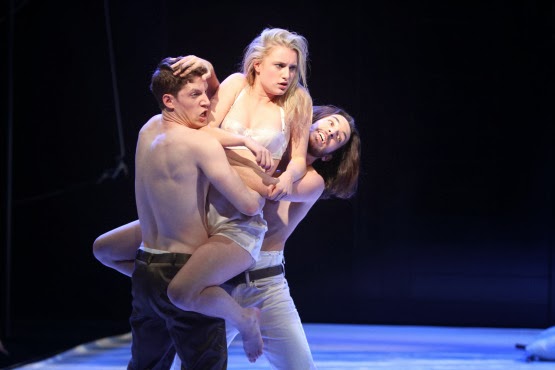
| The cast of Pericles at TFANA (Photo: Richard Termine) |
Pericles
is a foolish young prince, ready to follow in the footsteps of other foolish
princes who vie for the hand of a king’s daughter in Antioch. This is the story with a shocking
riddle. Since it’s perfectly clear what
the answer to the riddle is, and only Pericles has solved it, one wonders if
the other princes were too afraid to say it out loud. Their skulls, perched on poles seen through
that wonderful portal at the back of the stage, are a clear warning to any
princes who want the king’s daughter.
The King of Antioch, in a rather operatic performance by Earl Baker Jr., isn’t willing to give
up his daughter to marriage, since he is committing incest with her. His daughter, nicely played by Sam Morales, is not as enamored of her
father as he is of her, so earns a bit of sympathy. But not from Pericles. The scenes in Antioch set the tone of the
play in which royals are clothed richly, but the style is dependent on the
character. The King of Antioch is in a billowing
and shiny fabric in a rich jewel tone.
His daughter is in a translucent version. Costume designer Constance Hoffman does a fine job
differentiating the island nations in dressing the characters.
The
last particular person we meet in Antioch is Thaliard, whom the peevish King
orders to find and kill Pericles for guessing the riddle and becoming a threat
to the king’s standing in the world.
Reputation, reputation. Thaliard
is marvelously played by Oberon K.A.
Adjepong, who reappears in Tyre without achieving his goal.
The
scenes in Tyre are perhaps the dullest with the most tangled language. Here is where we cannot blame the actors or
director but rather the sloppy transmission of the play through the ages. Philip
Casnoff as Helicanus is stuffy and pompous and rather monotonous, so I was
never really sure if he was loyal to Pericles or not. Pericles and Helicanus decide the safest
thing for the former to do is to travel until Antiochus gets tired of chasing
him or, preferably, dies. This is not
merely to protect Pericles’ life — Antiochus is not above making war against
Tyre in order to punish Pericles, based upon an alleged slight. To avoid involving his kingdom in his
troubles, Pericles loads his ships and travels.
The
beautifully designed theatre allows for many entrances so the actors in
famine-devastated Tarsus crawl moaning onto the stage from the rear of the
house. Will Swenson is very effective here as Cleon, Governor of Tarsus,
although he often relies too heavily on his beautiful voice. As his wife Dionyza, Nina Hellman goes from grateful to villainous through the course of
the play and excels at both (and then takes a turn as an unrecognizable Goddess
Diana). Pericles’ arrival with food for
the starving nation makes him a beloved hero in Tarsus, but he continues his
travels.
Pericles’
first shipwreck lands him alone on the beach at Pentapolis, where apparently
the people are very nice and generous.
In a tedious scene, three fishermen talk about nothing on the beach
until the bedraggled shipwreck victim comes upon them. They help him to enter a jousting contest for
the favor of the King of Pentapolis, Simonides, who is warmly and wittily
played by John Rothman. The various young men jousting are also vying
for the affection of the king’s daughter, Thaisa, a lovely young woman who is
as kind as her father, played by Gia
Crovatin. In his battered armor and
torn clothes, Pericles (still utterly charmless as he is still played by Mr.
Camargo) wins her heart, the king approves, and the couple is married. It is in Pentapolis that Pericles learns of
the death of his father, whom we did not meet when we were in Tyre, so he must
take upon himself the yoke of leadership.
He and his now pregnant wife Thaisa head back to Tyre. Which, alas, must be accomplished by boat.
 |
| Christian Camargo, Gia Crovatin. (Photo: Henry Grossman) |
The
second storm at sea is enacted onstage by actors swinging on ropes, and Thaisa
screaming as her time comes near. She is
accompanied by her servant Lychorida, well played by Patrice Johnson Chevannes.
Thaisa’s child is born healthy, but the mother apparently dies in
childbirth. Thaisa’s body is placed with
ritual, jewels, and gold into a coffin and sent overboard as the sailors try to
save the ship. Pericles names his
daughter Marina and lands next back at Tarsus, where he leaves the upbringing
of his now motherless daughter to his old friends Cleon and Dionyza. They are delighted to take in the beautiful
child, particularly since Dionyza has her own daughter and can bring them up
together. Pericles leaves his wife’s old
nurse Lychorida with his daughter and goes off to Tyre.
Meanwhile,
on another island nation, Ephesus, a coffin washes ashore and is brought to the
local lord, Cerimon, who is a physician.
Earl Baker Jr. reappears in
this much less showy role, and does very nice work as he inhabits this
primitive physician. Cerimon discovers
that the body in the coffin is not dead after all. Thaisa, believing her husband and daughter
dead in a shipwreck, goes off with Cerimon to the temple of Diana where she
will live her life as a votaress of that order.
As
in The Winter’s Tale, 16 years pass
so that the baby will be a young woman for the second half of the play. Marina, still in Ephesus with Dionyza and
Cleon, has grown to be perfect and beautiful and virtuous. Marina’s nurse Lychorida has died, leaving
her alone with Cleon and Dionyza, whose daughter, while sweet, is a clod next
to Marina, which is demonstrated onstage as the dear friends dance together – Sam Morales reappears in the silent
role of Dionyza’s daughter, and is delightful.
All the boys fall for Marina, so Dionyza decides she must die. She calls upon Leonine (well played by Zachary Infante), a servant who clearly
is infatuated with Marina, to kill the girl.
He fails, and pirates come and take her away to Mytelene, where they
sell her to a bawd, who is hilariously played by Patrice Johnson Chevannes.
 |
| Earl Baker Jr., Christian Camargo, Lilly Englert, Gia Crovatin, and Raphael Nash thompson. (Photo: Henry Grossman) |
Lilly Englert plays Marina. I’ve seen her work before and enjoyed it, but
this time I just could not fall for her virtuous Marina. Physically she was all she should be, fearful,
proud, disdainful. But Ms. Englert could
not convince me that this girl could convert the pander and the customers to
just sit and listen to her talk or sing or dance. Tough role, Marina.
Meanwhile
back in Tarsus, Cleon berates his wife but can do nothing as they all believe
Marina is dead. When Pericles returns
for his grown daughter, he is shown her gravestone. Devastated, he vows to never change his
clothes, cut his hair, or bathe and goes off in another ship, this time with
his buddy Helicanus. They arrive in
Mytelene, and the converted Governor hopes that Marina can convince the man to
speak, eat, live again. Marina sings
with a friend, gets no response, talks to him, touches him. She gets a response to that, and it is
rage. They discover themselves to one
another and all is well — this scene should be magical, and while Mr. Camargo
is a bit more believable than usual, the scene falls flat and feels forced. Pericles is transformed to a man who must take
revenge on his old friend Cleon, but first must make a sacrifice to Diana,
which means going to Ephesus, where, you guessed it, the father and daughter
are reunited with Thaisa.
At
last, it’s almost over.
Director
Nunn has cast a threesome of divergent actors as the threesomes that appear in
the many locales of the play: In Tyre,
they are three unnamed lords, in Pentapolis three unnamed fishermen, and the
three reappear in Ephesus and Mytelene individually. These actors include one of my favorites at
TFANA, John Keating, another who is
not my favorite Zachary Infante, and
a third with whom I am not yet familiar, Ian
Lassiter. Each one does his best
work when not part of a threesome — Keating funny and touching as the pander in
Mytelene, Infante very good as the reluctant murderer in Tarsus, and Lassiter grown
to a three-dimensional human as the converted Governor Lysimachus in Mytelene.
Keating is fine in all his roles, clearly the most experienced Shakespearean
actor of the three.
Robert Jones’ scenic design
is marvelous, in concert with Stephen
Strawbridge’s lighting design.
Fights by J. Allen Suddeth
were rather disappointing, but the choreography by Brian Brooks was pleasing, as were music and songs by Shaun Davey. The evening begins with music, string
instruments and percussion, all very well done by Pigpen Theatre Co., with John
Blevins, Philip Varricchio, and
Jessica Wang beautifully accompanying the action of the play from the
mezzanine level of the theatre.
All
in all, a pretty good production of a difficult and rather nonsensical play. The designers, director, and performers all
used the space of the Samuel H. Scripps Mainstage to its fullest extent and did
their best with a “mouldy tale.”* If you’ve
seen Pericles, you needn’t see it again. If you haven’t, this production at TFANA may
be worth your time, if you’ve got 2 ¾ hours to spare.
*Ben
Jonson on Pericles, “Ode to Himself” (1631)
~ Molly Matera, signing off....not to re-read Pericles.



 Posts
Posts

