All the superlatives have been used up on Julie Taymor’s various productions over
the years, so I’ll try to refrain.
That’s not easy, however, in light of this scrumptious presentation of William Shakespeare’s A Midsummer Night’s Dream — a
fitting inaugural production of the new permanent home of Theatre for a New
Audience: the Polonsky
Shakespeare Center
in Brooklyn.
A Midsummer Night’s Dream is a delectable feast for language
lovers, comedy and romance lovers. This
production is imaginative, light, sprightly, clever, funny, well designed, well
acted….superlatives rain down.

After the debacle that was Ms. Taymor’s film version of Shakespeare’s
The
Tempest, my faith is restored by this staging of Midsummer. Here, Ms. Taymor uses a hodgepodge of technology
and arts available to theatre and circus, and blends them to a euphoric
wholeness that never overwhelms the words Shakespeare gave us (and the actors)
in this beloved play.
Once we’ve gasped at the beauty and cleverness of the active
scenic design — very active — we are enthralled by Puck, in white face, chalky
like a sloppy jester, played by the extraordinary Kathryn Hunter. Hers is a
highly intelligent, impish and athletic Puck, doing aerial acrobatics and leading
all the players, human and fairy, between Athens
and the magical wood “a league without the town.”
You may have heard that the stage is filled with
children. That’s true, playing the
sprites and fairies of the forest, singing, swooping, creating the mist and the
skies, almost flying. These images are
helped along by the organic choreography by Brian Brooks. Musicians Jonathan Mastro and Wilson Torres carry the children and us
to the fairyland to meet Titania, Oberon, Mustardseed and the rest on waves of
music by Elliot Goldenthal. All the
designers combined in this production created a wonderland for us, including Es Devlin (Scenic), Constance Hoffman (Costume), Donald Holder (Lighting), Matt Tierney (Sound), and Sven Ortel (Projection Design).
The stage, the balconies, the edges and tops and bottoms and
sides are all well used — characters disappear into trap doors, up to the
heavens, backward and forward, and the trap doors provide still more levels for
the actors to play in. From the lovers
to the mechanicals, this ¾ stage and above production afforded space and angles
and highs and lows.
 |
| Tina Benko as Titania |
Tina Benko’s towering
Titania (children playing fairies aids in this image) has ivory skin and a musical
voice making for a sensual and funny and extremely pale embodiment of fair
Titania. In stark contrast to Titania’s whiteness was the darker than deep
brown of David Harewood’s Oberon, his magnificent voice commanding then cooing and
wooing. Shakespeare’s verse flows
trippingly on the tongues of these two well-matched artists.
 |
| David Harewood as Oberon, Kathryn Hunter as Puck at right |
Back in Athens,
Egeus is well played by the always reliable TFANA stalwart, Robert Langdon Lloyd. Okwui
Okpokwasili and Roger Clark were
well suited to each other and their roles as Hippolyta and Theseus. The four lovers were quite delightful,
passionate, lithe, limber, enjoying a fine pillow fight abetted by the
fairies. Those disguised children even
play the magical forest, putting obstacles in the way of the benighted and
bewitched lovers lost in the woods. It
was all very clever fun. Good work by
the mix-and-match lovers, Mandi Masden
as Helena, LillyEnglert as Hermia, Zach Appelman as Demetrius, and Jake Horowitz as Lysander.
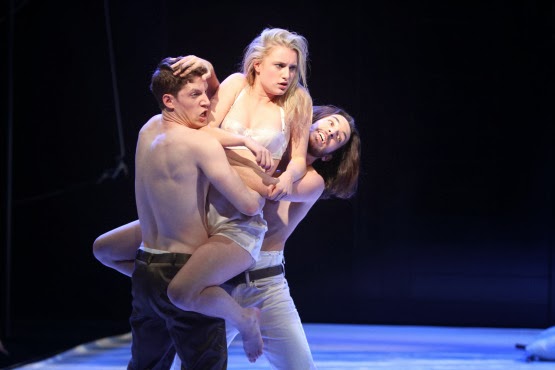 |
| Zach Appelman as Demetrius, Lilly Englert as Hermia, and Jake Horowitz as Lysander |
The Mechanicals are a motley crew, led by a charmingly
gauche Joe Grifasi as Peter Quince;
a haplessly huge Brendan Averett as
Snug the Joiner, the frightened lion; a sweet-voiced Zachary Infante as Francis Flute and a femininely feisty Thisbe; William Youmans as Robin Starveling, an
easily affronted Moonshine; Jacob
Ming-Trent as Tom Snout, or The Wall; all mastered by the remarkable Max Casella as Nick Bottom, the (dream)
weaver. The edits in the script were
made with a light precise touch, nothing was missed, least of all Philostrate’s
prattling about the various offerings for entertainment at the Duke’s nuptials. As played by Puck, who knows how to entertain
a crowd, Philostrate passes by the hemming and hawing about what play was to be
presented — we want Pyramus and Thisbe, and we are not disappointed.
The only flaw in the TFANA’s brand new Polonsky Shakespeare
Center is that the central section of the orchestra is not adequately raked —
from my second row seat, I could not see action just left of center especially
when the actors were lying or rolling or otherwise on the ground, as fairies
and imps and lovers are wont to be. Bits
in that spot garnered laughs, but not from me – and the fellow in front of me
was not inordinately tall
Midsummer Night’s and Bottom’s Dreams are many-leveled,
quite literally, as Ms. Taymor likes to lift and swing her sets and her actors
into the heavens and down to the ground (thanks and praises to Airealistic for the aerial design and
flight), starting with Puck in the opening scene. The stage starts off spare and grows to the
limits of imagination and a midsummer night’s dream. This production happily runs to January
12. Start your new year off right!
~ Molly Matera,
signing off to re-read the play, and check the savings account to see if she
can afford to go again.



 Posts
Posts

