Brooklyn Academy of
Music
The last week of November, my friends and I traveled
underground to BAM Opera House (rain, rain, rain, but that evening the MTA did
its job) for a program by Philip Glass:
The Etudes. There are twenty of them,
and they were played in chronological order starting with Mr. Glass himself followed
by nine virtuoso pianists. The first act
was spectacular, downright awe-inspiring.
Mr. Glass’ music requires advanced technique (apparently he wrote them
to force himself to play better) but they’re not just exercises. There is depth, intricacy, and passion. By
the 14th etude they start sounding rather alike, but just watching
the very different styles of the pianists was fun. I am a new fan of Timo Andres, Jenny Lin, Bruce Levingston, and Tania Leon.
 |
| Philip Glass surrounded by great pianists. Photo credit Stephanie Berger, courtesy BAM |
The Vineyard Theatre
For my friend’s autumn visit to the city, we went to the Village
to see “Billy & Ray” at the
Vineyard Theatre. It’s about the writing
of a screenplay for the great Double Indemnity by Billy Wilder and
Raymond Chandler (based on book by James M. Cain which everyone disparaged as
trash). The play was written by Mike Bencivenga and directed by Gary Marshall, who of course knows how
to direct in any medium, so it was put together well. The play was a lot of fun for me since I got the
in-jokes about the movie, the actors, the ways of the studio. My companion’s brother would have enjoyed
it. While my friend enjoyed the play
somewhat, she definitely looked at me questioningly each time I laughed at
something she didn’t get. It was only at
intermission that I discovered she’d never seen Double Indemnity; and that
she didn’t know Fred MacMurray had played a sweater-wearing dad named Steve
Douglas in My Three Sons (one of the laugh lines for old folk like me). I tried to explain what Double Indemnity
meant to me, since I knew MacMurray as that dad and seeing him in Double
Indemnity was mind blowing, realizing that the middle-aged actor was once
sexy and seriously noirish in the film that started noir. I compared the
experience to seeing Robert Young, seen in the same decade as My Three Sons
playing the kindly Dr. Marcus Welby — a family doctor who still made house
calls — and the shock of seeing him as a Nazi in a Hitchcock film. My friend
had never seen Marcus Welby either. Clearly I watched way too much television in
my youth.
The play’s fun for those of us in the know and reasonably well
structured until the end, when it runs into the problem any “fact” based story
has in winding up — telling the audience what happened to Chandler afterward
and Wilder and the movie, etc., and film noir itself. Larry
Pine was more than competent but not quite on as Chandler and Vincent Kartheiser,
while better than I expected as Billy Wilder, was still not the Billy in my
head (even though Billy must have been young once). Still I wouldn’t go so far as to say he was good.
The scenic designer used the space well, and the period music was spot on. So it was a pleasant if not scintillating
evening, and I was delighted to know that Chandler was well aware that doors
open into rooms, not out into hallways, so that great, nail-bitingly tense
scene in which Barbara Stanwyck hides from Edward G. Robinson behind the open
hallway door was “grammatically” incorrect. Billy Wilder didn’t care for reality, but
rather for the dramatic moment.
Do see Double Indemnity,
the film, if you haven’t — or even if you have.
The play’s fun, but does not hold a candle to the film it holds up for examination.
 |
| Kartheiser as Wilder and Pine as Chandler. Photo credit (c) 2014 Carol Rosegg |
A Delicate
Balancing Act at the Golden Theatre
Edward Albee’s A
Delicate Balance is back on Broadway, but this one does not compare to the
1996 production, despite Pam McKinnon
directing. While I loved her production
of Who’s Afraid of Virginia Woolf,
this evening is well staged, but not well directed mostly because it’s not well
cast. I hesitated to see this production
because I did not want to sully the memory of the perfect production of the
play we saw on Broadway in the 1990s — with the brilliant George Grizzard and
Elaine Stritch and Rosemary Harris. Sometimes
— well, often — one should follow the gut.
The Leading Lady, Agnes, is a
tough creature to play: she is the delicate balance. Glenn
Close doesn’t get it, coming off as merely officious. John Lithgow is also rather shallow and dull as her husband. As their
daughter, Martha Plimpton is also
loud and shallow and dull.
Lindsay
Duncan
is downright brilliant in addition to being courageous for taking on a role we
all remember Elaine Stritch doing. Ms. Duncan
does a great deal more than hold her own. Bob
Balaban (pitch perfect, tonally and physically) and Claire Higgins
(mad and rather hateful, meaning perfect) as the frightened neighbors Harry
& Edna are fabulous. It made me happy just to see them enter the
stage. They nailed it.
One of my favorite aspects in
the scenic/lighting design were the shadows of people about to enter – down the
stairs, from the kitchen area, toward the front door, all the visual
“foreshadowing” was marvelous. The staging and design elements were
cleverly “off balance.”
I
know A Delicate Balance, and it’s not
a dull play. I should never have time
to sit and think, “I am so bored with these rich people, they should go out and
work, why is the drunk the only interesting thing onstage, what is the issue
with the bedrooms with these people, they have servants and no guest room??” But that’s how I felt the evening I saw this
production. The last 3-hour play I saw
was Stoppard’s Indian Ink at the
Roundabout, and I wasn’t bored for a moment. Big difference.
Six
actors, of which three do fine work — really, Lindsay Duncan is the epitome of
alive onstage, living as a whole person (however broken as an alcoholic, or, as
Claire insists, a drunk) with relationships, history, power, humor, and guts. To see her work, and that of Clare Higgins and
Bob Balaban, is a delight. But there
must be a better way.
Save
your money on this one.
 |
| Lithgow and Close. Photo Credit (c) 2014 Brigitte Lacombe. |
The Last Ship at the Neil Simon Theatre
Sting’s new
musical (music & lyrics by Sting,
a.k.a. Gordon Sumner) has a terrific book by John Logan and Brian Yorkey,
is directed by Joe Mantello, and rather
thrillingly choreographed by Steven
Hoggett. When we saw it, we
predicted: The Last Ship will be touted as and win awards as the best
new musical of the year. Unfortunately,
the wrong people wrote reviews on it. If
you like Sting’s musical progression over the years, you’ll like the score. This
is not what he did with The Police, this is later Sting, which leans more
toward older music, music of the working people, which is pretty much the play.
The critics are
wrong about The Last Ship. It’s
musically exciting, emotionally engaging, and different from the usual Broadway. The choreography is suited to the characters
doing the dancing, and the scenic and lighting design (David Zinn and Christopher
Akerlind, respectively) are fabulous.
Michael Esper as Gabriel
returned to his hometown and Rachel Tucker
as the girl he left behind lead an excellent cast. We had a wonderful
evening. The play does not need Sting to
appear onstage, he’s already there in its heart and sound, although he will
join the cast as a means to bring more people into the theatre. Unfortunately, this means those who see Sting
will miss the hearty and heartfelt performance of Jimmy Nail.
A fine Christmas
gift it would be if this musical play’s box office turns around and it runs on,
despite foolish critics.
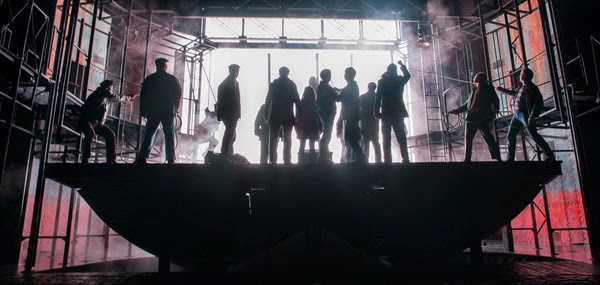 |
| A scene from The Last Ship. (C)2014 Sara Krulwich/NYT |
~ Molly Matera, hoping everyone is enjoying their preparations for
holidays, which should include seeing some live theatre.




 Posts
Posts


