Cymbeline is a late play by William Shakespeare, meaning he’d done with the histories, the
straight comedies and romances, and was ready for riskier works to be produced
indoors in more intimate venues than the Globe.
I decided, as I was ruminating on this production, that this play’s theme
has to do with false reports and betrayal. May I assure you, no one onstage or
in the audience noticed.
The play has its “problems,” but no one cares, for if it is
approached from askew, hilarity ensues. Daniel Sullivan’s production for The
Public Theater’s Shakespeare in the Park (that is, at the Delacorte in Central
Park) fits the bill.
Director Sullivan did judicious cutting in his production and
incorporated delightful doubling and imaginative additions. The program lists 14 characters and assorted
gentlemen, lords, ladies, soldiers, messengers and captains, all played by nine
actors (seven men, two women).
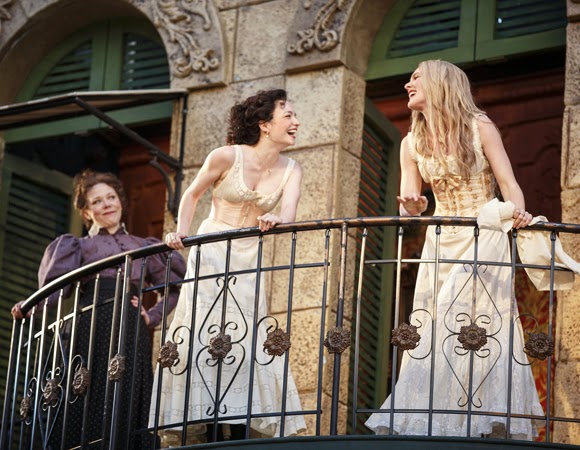
Let’s consider the main character and her love: Imogen and Posthumous Leonatus. She the heiress to a kingdom in Wales, he an
orphan raised by Imogen’s father, King Cymbeline, the two married in secret. Also vying for Imogen’s love is Cloten, the
cloddish son of the present Queen — who is not mother to any child of Cymbeline. In comparison to Cloten, Posthumous is a
catch. However, judged on his own, Posthumous is a cipher until he becomes an
ass.
 |
| Lily Rabe as Imogen, Hamish Linklater as Posthumous. Photo credit (c) 2015 Carol Rosegg. |
Thanks to the bravura performance of a problematic role by Hamish Linklater, once in Rome we see
the shallow, rudderless fool Posthumous is, and from being a cipher he becomes a
fool then turns into an ass. The utterly
charming Mr. Linklater makes him almost pitiable, had he not attempted to
pervert his good servant Pisanio (played to perfection by Steven Skybell) to kill his wife Imogen based upon false evidence (from
Iachimo, more on him anon) and his own lack of faith. Not to mention intelligence.
Once her father banishes her husband, Imogen’s only ally at
court is Posthumous’ servant Pisanio. Steven
Skybell is punctiliously if oddly dressed, adores his master and his mistress,
abhors the Queen and Cloten, and fears the King.
The wonderful Lily
Rabe is Imogen, feisty and foolish, faithful and fierce — she has a temper
which delights us as she physically punishes Iachimo for his lascivious
behavior in Cymbeline’s court…. In Wales or in Rome, Iachimo lies like a dog on
a rug. But the traditional servant,
smarter than his “betters,” saves the day by judicious misleading and lying as
any good servant must.
Banished from Wales, Posthumous does not appear to be
suffering overmuch. Among his playmates in Rome is Iachimo, a viscous Italian
with money but no work, except perhaps as a nightclub warbler. Daniel Sullivan made a
rather tedious scene of male braggadocio into a musical number using Raúl Esparza perfectly. In a suit a little too shiny, with song
stylings a little too slick, this Iachimo crooned like a cross between Sinatra
and Dean Martin. He was sleazy, he was oily, he was brilliant. Then a woman dressed like a flapper in
a slinky dress and short black wig joined him, and they danced sensuously
together. One does not expect a show-stopping number a third of the way through
a Shakespeare play, but we got one.
 |
| Imogen with Iachimo played by Raúl Esparza. Photo credit (c) 2015 Carol Rosegg. |
Meanwhile back in Wales, the other fool, the loutish Cloten
(also played by the brilliant Linklater with a pageboy blond wig that brings to
mind a series of dumb movies) attempts to crudely and tunelessly woo his
stepsister, since both his mother the queen and his stepfather (clearly on
drugs) want the two to marry.
Cymbeline, King of Britain, is a grumpy old pill-popping monarch
played gruffly by Patrick Page, who
also lends his voice to Posthumous’ patron in Rome, Philario. Cymbeline’s second wife, the present unnamed
Queen and mother of Cloten, is joyously played by Kate Burton, who has a marvelous time with the traditional wicked
stepmother. She also slips into a male
identity (alas not a powerful performance), Morgan, who is actually Belarius,
long banished from Cymbeline’s court due to false report.
 |
| Hamish Linklater as Cloten, Imogen's stepbrother. Photo credit (c) 2015 Carol Rosegg. |
Belarius and Posthumous, both loyal to Cymbeline, are both banished
from court doubtless due to the machinations of the comic book evil, poison-dabbling
queen, whose little white dog doesn’t even like her — it spends its entire
stage time trying to wriggle out of her arms.
Happily the dog is rescued by Cornelius the court doctor played by Teagle F. Bougere, except when he’s
playing the Roman ambassador, Lucius. Or
at the same time….
In Rome, there are two layabouts who look rather like the
two sycophantic gentlemen in Cymbeline’s Court, and the same two actors are
those mountain folk whom Imogen-disguised-as-a-boy falls in with, who are also
her long lost brothers. These multiple
characters are snidely, brutishly, and sweetly, respectively, played by David Furr and Jacob
Ming-Trent.
Back in Rome, Iachimo finagles a foolish promise from the
annoyingly naïve Posthumous that causes all the ruckus with Imogen, which
causes her to disguise herself as a boy escaping the court and traveling to
Milford Haven. Whereupon she chances to meet
old Belarius, a.k.a. Morgan, and his two sons, who are not his sons at all, but
Cymbeline’s missing heirs whom Belarius kidnapped twenty years before when he
was wrongly banished from Cymbeline’s court.
And then she mistakes a headless dead guy for her husband.
Got that?
It’s that kind of play.
And I left out a whole lot of stuff.
Back and forth and round and about, the cast members are
doubling roles and watching each other as if it’s a play within a play. And the scenic design by Riccardo Hernandez suggests it is. David Zinn’s costume design and Charles G. Lapointe’s hair and wig design help bring it all
together.
All the absurdities of the plot upon plot intertwined with a
trope and a meme make light of the heartbreak of Imogen and Posthumous. The actors do not. There is funny work done by all, and some
heartbreaking work as well. This production
of Cymbeline most certainly works;
just don’t think too hard, it tangles the brain.
As tradition happily has it, all the confusing plots and
sub-plots are tied up by evening’s end, and celebrated with an antic and
acrobatic dance choreographed by Mimi
Lieber, making for a wholly delightful evening in Central Park’s Delacorte
Theatre with a fine company of players.
~ Molly Matera,
apologizing for taking so long to write this – there is a bit more than a week
to go in the run of this summer production, so get yourself to the virtual or
actual line for Shakespeare in the Park!






 Posts
Posts

