Showing posts with label Joss Whedon. Show all posts

Sunday, June 30, 2013

"Much Ado About Nothing" in the Whedonverse


Kenneth Branagh’s 1993 film of Much Ado About Nothing had one of the wittiest title shots I can recall.  I burst out laughing in the theatre when I first saw it, and it still tickles me.  It’s over the top, as is much of the film.  I like Branagh.  I love Joss Whedon.  I like Kenneth Branagh’s work as an actor better than that of Alexis Denisoff.  And yet, watching Branagh’s delightful Much Ado, his Benedick seemed to be overdoing it a bit — downright broad for film.  This did not diminish my enjoyment of that Much Ado then or now.  Set in a vivid and hot Italian landscape in another century, Branagh’s film was more. exuberant than Whedon’s modern version, which setting required something resembling realism. 

Joss Whedon said in an interview that he felt some of the choices made by characters in Shakespeare’s Much Ado About Nothing had to have been made under the influence, which makes sense.  Perhaps therefore everyone in this film is drinking excessively.  While Kenneth Branagh’s production of Much Ado was lush, in Joss Whedon’s film everyone is a lush.

The innocence of a period film’s ingénue and juvenile (Hero and Claudio) cannot be captured in a film set in the 21st century.  That presents a problem, yet not as great a one as the fact of Don Pedro and his followers.  They wear no uniforms, yet they carry guns.  They are not soldiers.  In what wars do civilians in well-cut suits carry guns?  Drug wars?  In the 21st century, must give one pause to wonder if Don Pedro’s a drug lord.  And his brother Don John tried to strike out on his own.  What was “this ended action” (I.i) about?  The scene in which Benedick challenges Claudio is extremely well acted by Don Pedro (Reed Diamond), Claudio (Fran Kranz), and Benedick (Denisoff), but that he was carrying a gun made Benedick a troublesome personage.  It tends to make him look like a hood.  Don Pedro and Benedick and Leonato and Claudio don’t seem like they’d be involved in the illicit drug trade.  This problem and that of Claudio’s churlish behavior at an American 21st century wedding are slight distractions from the pleasures of the film.
Amy Acker as Beatrice and Jillian Morgese as Hero.  (c) 2012 Elsa Guillet-Chapuis & Roadside Attractions

Alexis Denisoff surprised me with his adept use of Shakespeare’s language in a modern setting.  The chemistry between Denisoff and Amy Acker has been well documented in their years together on Whedon’s television series, Angel.  I never had doubts about Acker — I had complete faith she was great casting as Beatrice, and the pairing did not disappoint.  Ms. Acker’s Beatrice is highly intelligent, her wit sharp, her heart aching.  The pair was funny and believable whether fighting or loving. 

Reed Diamond is excellent: straightforward and real as Don Pedro whether serious or comic.  I’ve always liked his work, but this side of him surprised me, quite pleasurably.  Fran Kranz is sweetly hilarious as the foolish Claudio.  The party scene in which Claudio rises from the pool in a snorkeling mask (see poster) only to be misguided by the heads above water belonging to Don John, Borachio and Conrade was incredibly funny and quite possibly the best I’ve seen that scene done.

Sean Maher, whom I would not have envisioned as Don John, was a fine, understated villain and I quite liked his performance.  Clark Gregg was a goodhearted Leonato, struggling with what seems to be (but regrettably probably is not) an outdated character and trying to bring him likeably into the present.
Lenk as Verges and Nathan Fillion as Dogberry.  (c) 2012 Elsa Guillet-Chapuis & Roadside Attractions

I’ve been a fan of Nathan Fillion since Firefly, and am delighted that he took on Dogberry for this film.  He plays the famously mangled lines absolutely straight, so the humor really works.  Dogberry’s ego shines through, and just little touches make the “low” humor parts of the story truly funny.  Clearly, physical comedy need not be violent.

Jillian Morgese was practically a real live girl as the ingénue Hero, filling the blanks of that thankless role with a level of self-confidence in addition to obedience.

Beatrice eavesdrops....
Ashley Johnson as Margaret was excellent, old-fashioned while modern, innocently knowing.  Emma Bates was very good as Ursula, and Riki Lindhome was quite interesting as Conrade, a different sort of companion for Don John.

Dull as dishwater, however, was Spencer Treat Clark as Borachio until the moment he heard Hero was dead, which brought to him a spark of life.  Tom Lenk as Verges was dull and obviously acting.  Romy Rosemont as the Sexton brought some gravitas to the legal proceedings but, more, made us believe she had a life waiting for her when those danged fools stopped talking.

Elsa Guillet-Chapuis as the Photographer was focused and intent on her work, a naturally unnatural part of the proceedings. 

The costume party scene is a sultry modern gas; the world of excess that is in this 21st century Much Ado seems so much more vulgar than the aristocratic excesses of the past.

I keep comparing these two very different films of the same Shakespeare play, but they’re both wonderful and exciting in their very different ways.  Joss Whedon’s film is in a lower key than Kenneth Branagh’s, as it must be since it is set in the present and in a small, intimate, black-and-white film.  (I love black and white.  It seems some how more real to me than color.)  And Whedon’s addition of a silent prologue providing us a glimpse into the back-story of a modern Benedick and Beatrice’s relationship was priceless. 

While the 21st century works just fine for Shakespearean tragedy, somehow this romantic comedy that is the beginning and model for all romantic comedies just didn’t quite work in our time.  Joss Whedon’s Much Ado About Nothing is a film I’ve been looking forward to for years, and while I enjoyed it, I did not walk out of the theatre whistling, or floating on air.  I never thought I’d say this about a Whedon Shakespeare film, but although I liked it, I did not love it.

~ Molly Matera, recommending the film, while accepting the disappointment of reality.

Tuesday, April 23, 2013

My Year In Shakespeare

Once a year, some of us, we few, we happy few — or, as my cousin calls us, people with greasepaint in our blood — celebrate Shakespeare’s birthday.  Why celebrate the birth (and death) date of someone who wrote over 400 years ago, is not in my family tree by any stretch of the imagination, and is recalled as school days torture by the majority of people I talk with every day?  Because listening to and reading Shakespeare sharpens my mind and has afforded me great pleasure over the years, as well as being the first building block in a number of friendships that have blessed my adult life.  I am grateful, more than once a year, to the Bard and those actors/directors/teachers/friends who taught me how to take his words in and make them mine, in particular Eric Hoffmann and the late Robert Mooney.

The year’s wheel has come full circle, so I started writing down all sorts of fascinating things about Shakespeare, but then I had too much of a good thing, so I had to stiffen the sinews and start from scratch.  While setting goals for next year (for which I intend to plan ahead, just as I probably did last year for this), I’ll move apace with this year’s musings. 

Once a year my friend Horvendile posts to his blog, A Likely Story, a list enumerating things he’s done — how many poems he’s written, how many plays, short stories, how many pints of Guinness or bottles of wine drunk, among other things (and thereby hangs a tale), as well as every play he’s attended.  Many of the last will overlap with my list of plays seen because we cannot get enough Shakespeare.

I come to list Shakespeare, not to praise him, the plays and books I’ve seen and/or read that were by or about Shakespeare in the year since I last posted to the Happy Birthday Shakespeare Blog.  What would be impossible would be to list how many of Shakespeare’s phrases I have heard in everyday conversation without anyone realizing the debt.  There are too many to count, so that way madness lies.

Last year I blogged about the role Shakespeare played in my theatrical experience in terms of performing and directing.  I said it then and I’ll say it again:  I’m no scholar or academic, and my experience with Shakespeare is certainly neither as consistent nor as long as I would like.  Still I remember learning to scan, learning how the verse (or lack thereof) can inform an actor more than 400 years on how to say a line, what it means, where the stresses go.  This is a remarkable gift.  (Or curse, when the actors strutting their hour onstage mangle the verse, which is why it can be so rewarding to experience the stories anew in a foreign tongue.)  So although I haven’t acted Shakespeare in some time, I continue to attend productions of his plays several times a year, I re-read some of the plays each year and someday soon I’ll re-read the entire canon, preferably aloud with friends.

Just before we celebrated Shakespeare’s birthday last year, I saw the excellent Simon Callow perform Being Shakespeare which was written by the scholar/academic I am not, Jonathan Bates.  This is an historical fabrication bent on clarifying that Will Shakespeare had education and experience enough to have written the plays and poetry attributed to him, and happily had a number of monologues and soliloquies included in it.  This in contrast to Mark Rylance’s play, I Am Shakespeare, which I did not see but rather read.  It’s a lot of fun, but did not convince me that anyone besides Will wrote the plays.  (I still haven’t seen Anoymous.)


Will was busy, so Artie posed in a ruff.  Ruff.  (c) 2013 Eric Johnson Jr.

As summer 2012 dawned, I saw the NYC Public Theatre’s delightful production of As You Like It on a perfect evening at the Delacorte in Central Park.  Droll and heartfelt, it transported us all to joy.

In October we trekked to lower Manhattan to see a production of Hamlet from Shakespeare’s Globe.  I called it a Wee Hamlet because of the charmingly compact set the company traveled with and the short playing time — due to the very fast delivery of a streamlined script.


A representation of The Globe in London. 

In November we journeyed to the Brooklyn Academy of Music for an unusual production from the Netherlands — it was an all-day affair featuring news crawls, newsreels, no intermission, however imbibing, wandering and tweeting were allowed.  This was Roman Tragedies, which is a mash of Coriolanus, Julius Caesar, and Antony & Cleopatra, by the Toneelgroep Amsterdam.  It was close to six hours, mostly fascinating.  Oh, and it was in Dutch.  No, I do not.

In the new year, a delightful Much Ado About Nothing (by the same company that did a marvelous Taming of the Shrew last year, Theatre For a New Audience at the Duke Theatre in Manhattan) and most recently the Royal Shakespeare Company’s Julius Caesar at the BAM Opera House.


A few decades ago (guess the year), my friends Judy and Alan and I purchased the best bargain of our lives — New York’s Public Theatre intended to perform the entire canon of Shakespeare over the course of five years, and we paid up front what then appeared to be an enormous sum to subscribe. For that investment, we saw all of the plays at least once, with extra productions over a period that stretched beyond those original five years, including reserved seats even at the summer venue, the Delacorte! Final tally: $11 per performance. The like will never come again.

One of those friends is Alan Gordon, author of the Fools Guild Mysteries whose latest publication is an essay in the new book Living With Shakespeare, an anthology of essays by writers, actors, directors, and others edited by Susannah Carson and Harold Bloom. This book has given me hours of delight and I’m not even halfway through. The evening before Shakespeare’s birthday, the editor and several contributors chatted about the book and Shakespeare and the plays at the National Arts Club in Manhattan. An evening’s discussion among friends and strangers about Shakespeare — who could ask for more on the eve of the Bard’s birth.

Also in 2013, looking forward to (I can practically hear Carly Simon singing “Anticipation”) Joss Whedon’s “home movie” of Much Ado About Nothing due in theatres in June. Then… whatever productions at BAM or elsewhere catch my eye. 
 

Just when there was too much time between live theatre productions, Public Television provided the exciting Shakespeare Uncovered series, with Jeremy Irons, David Tennant, Derek Jacobi, Trevor Nunn, Joely Richardson, and Ethan Hawke exploring the texts, the sources, the lore of spending a life performing or directing Shakespeare.

Videos (or DVDs, I have both) recently watched include Roman Polanski’s Macbeth with Jon Finch, Francesca Annis, and Martin Shaw.  I saw this on a high school field trip to Manhattan in the early 1970s.  Just as the nuns hadn’t realized that Romeo and Juliet would show some bare flesh in Franco Zeffirelli’s 1968 film of Romeo and Juliet (how short-sighted of them!), I don’t think they realized the witches and Lady Mac would be naked — after all, the moors and stone castle floors of Scotland are quite chilly….  What I remember most clearly about the trip to see Macbeth was my friend Carolyn’s nails leaving marks on my arm when Macbeth’s head was lopped off by MacDuff. 


Shakespeare inspires.

With no malice aforethought but rather this birthday blog in mind, I’ll take note of anything Shakespearean that may come my way over the next twelvemonth….and once again I’ll post it to the website dedicated to bringing together people who blog and love Shakespeare and … whatever else the Happy Birthday Shakespeare bloggers do at this year’s celebration of the Bard’s Birthday.

~ Molly Matera, off to re-read Coriolanus before I view the DVD….

Wednesday, May 9, 2012

Whedon Rules a Panoply of Superheroes


I had a wonderful time at the movies this weekend, watching Marvel’s The Avengers in a packed house.  Joss Whedon writes witty stuff and did not leave that talent behind for the screenplay for this long-awaited mega superheroes film.  The script is fine-tuned, detailed, well structured, exciting, and funny. Add to that Whedon’s other skill — he directs clearly, lovingly, giving his actors scope and allowing them to spread their wings – or whatever they have – to fly.  He tells the story, tossing bombs and reptilian or crustacean-like creatures as needed.

So what’s this movie about?  Super heroes who don’t play well with others will do when push comes to shove from external critters.  There’s such a fine line between fine lines and spoilers that I’m just going to make a list of the top-of-the-Hollywood Hills performances in this fun film:
The Avengers (c) 2012 Marvel

Robert Downey Jr. as Tony Stark, a.k.a. Iron Man is charming, witty, vain.  Downey brings a cool intelligence to Tony Stark and has a subtle but clear revelatory moment toward the end that is just part of the plot here, when he recognizes a link between himself and Loki.  Downey does it well, Whedon wrote it well, it’s a collaborative art.
Evans and Downey as Captain America and Tony Stark.  (c) 2012 Marvel.

Chris Evans as Steve Rogers, a.k.a. Captain America, is as realistically sweet, naïve, and powerful as we expect from his film last summer.  Don’t be fooled by his goodness, though – he’s tough as nails, confident, and insists on doing the right thing.

Mark Ruffalo as Bruce Banner, a.k.a. The Hulk, has created a quietly intense Bruce Banner and a damned funny Hulk – or, as Banner refers to him, “The Other Guy.”  He gets some massive laughs in this film, and deserves every one of them – as do the CGI artists.  Mark Ruffalo is the best Bruce Banner/Hulk ever.

Chris Hemsworth as Thor, a.k.a. Son of Odin, Demi-God.  He fell from grace out of Asgard, but came back to Earth to help the planet under his protection.  There’s an ‘aw shucks’ quality to Hemsworth that lends warmth to a character even more arrogant than Tony Stark.

Scarlett Johansson as Natasha Romanoff, a.k.a. The Black Widow, does fine work here.  Not surprisingly in a Joss Whedon script, she has lots to do showing Natasha’s physical and intellectual strengths.  And quite a lot of heart.  
Scarlett Johansson as Black Widow

Jeremy Renner as Clint Barton (never called that), always known as Hawkeye. Hawkeye’s a tough guy and Renner gets to do his dark and light sides, strength and pain, and I only wish he’d been onscreen more.

Clark Gregg as Agent Phil Coulson, dapper and neat, is disarmingly important.  His arrival invariably presages trouble despite his total calm and confidence. 

Samuel L. Jackson as Nick Fury, a.k.a. the Boss a.k.a. Director of SHIELD.  He’s basically the CEO who reports to a higher power, the World Council, who appear as shadowy faces on computer screens.  They are desk jockeys who don’t get it.  Fury manipulates, he drives, he puts people together and watches the explosions.

Tom Hiddleston as Loki, a.k.a. adopted son of Odin, Demi-God.  Despite the fact that Loki’s demigod outfit kept making me laugh, he is a dastardly and very cool villain.  He so enjoys being bad, it’s a delight to watch.  He revels in his mischief, and the angle of the shots of his grinning face are brilliantly composed.

Stellan Skarsgård as Professor Erik Selvig, is almost a cipher here, which is pretty odd, considering Skarsgård’s skills and what happens to Selvig in this story.  It’s a mystery.

Cobie Smulders as Agent Maria Hill, a.k.a. regular human.  Smulders smoulders, obeys orders, questions privately.  A mere human who’s tough and smart, the way Whedon likes his women.

Of the thousands of people listed who contributed to this film, I’ll single out only two more:  Cinematography by Seamus McGarvey was gorgeous, brisk, bright, gloomy, everything it needed to be.  Film Editing by Jeffrey Ford and Lisa Lassek (uh oh, more than two already) was razor sharp, contributing to perfect pacing.  Oh and the production design by James Chinlund was beyond cool, phantasmagorical, lyrical, and overwhelming.  Suffice to say, this film has been put together extremely well, so much more than I could have hoped or expected.

Whedon Rules.

Is it necessary to have seen Thor, Iron Man and Iron Man 2 and Captain America: The First Avenger to get this film?  Tough to tell, since I’ve seen all of them, but I think Whedon lays it out clearly and coherently in reasonably chronological order.
-         Immediate situation:  Fantastic secret complex invaded, people killed, people kidnapped, who’re you gonna call?
-         Establish who’s needed so that, one by one by one, Nick Fury’s people gather — and introduce — the superheroes, odd ducks, and outcasts who will comprise his team of Avengers.
-         What do you need in an action adventure movie?  Fast-paced coherent action; colorful, interesting, funny, sexy characters; things that go boom; things that slither; laughs; moments of quiet reflection (well, most action adventure movies don’t have this, and don’t really need it, so The Avengers gets Extra Credit for sneaking them in); more laughs, more explosions, flying things….  The beat goes on.  The Avengers has it all.

Actors leave their egos at home so their alter egos can do battle on the screen.  What do you get when you put a couple geniuses, an old-fashioned boy chemically engineered to be a superhero, and a demi god into a room together?  Fireworks.  Violence.  Broken furniture.  Does Black Widow tell the guys what’s what?  Of course she does.  Do they listen?  What fun would that be? 

If there’s a flaw to The Avengers, it’s the embarrassment of endings, a common feature in continuing sagas advertising their sequels in the last reel.  What appears to be the final shot is directly connected to Tony Stark’s revelatory moment, and is enough to say there’s more to come.  Then, in the way of such franchises, a whole new scene is included to tell you that. 

I can tell you that I cannot wait.

In closing, I repeat my advice to film audiences to show respect and courtesy to the thousands of people it takes to make a film, otherwise they may miss out on stuff after the credits.  The final bit of film in The Avengers is heartfelt and hilarious at the same time, and garnered applause from those hearty few of us left in the theatre to enjoy it.  Wait for it.

~ Molly Matera, signing off, but not logging off — now I can watch all the videos online about this delightful entertainment….

Saturday, April 21, 2012

The Cabin as Rubik's Cube


The poster for The Cabin in the Woods (“TCITW”) is a clue to the film, if you choose to analyze it.  The cabin itself is not what it appears.  Nor is the movie.
(C) 2012 Lionsgate.

I see no cause to be mysterious about my overall opinion, so first things first:  Go see this movie. 

Joss Whedon and Drew Goddard’s The Cabin in the Woods is fun, it’s a trip of the LSD sort, a kick, a blast.  When you have seen this, you’ll realize it is not a simple teenage slasher movie. It has elements of those, of course.  It also includes 1950s science fiction as well as gathering paranoia.

The movie has some jumps, some gasps and shrieks, and a lot of laughs.  In terms of laughing to breathlessness, one of my best nights in the theatre ever was the panty-wetting “Evil Dead: The Musical,” and The Cabin in the Woods pays its homage to the “Evil Dead” movies and all those that came before and after.  There is the eponymous cabin in the woods with a lake out back.  It is its own little world.  If the camera had ever pulled back so far, I wouldn’t have been surprised to see a snow globe.
A very cool alternate poster for The Cabin in the Woods.  (C) 2012 Lionsgate

The requisite characters are all here:  The Jock, The Dumb Blonde, The Egghead, The Virgin, and the Clown.  These five archetypes are portrayed to perfection by Chris Helmsford as Curt, the Jock/Alpha Male who’s actually on academic scholarship; Anna Hutchison as Jules, the dumb blonde who only just became either on the day the story starts; Jesse Williams as Holden, the smart nice guy; Kristen Connolly as Dana, who we’ll call the good girl — virgin is a bit much to ask in this day and age — and finally the wonderful Fran Kranz as Marty, the clown, fool, the stoner. 
Kranz as Stoner Marty, Helmsford as Jock Curt, and Hutchison as Jules. (C) 2012 Lionsgate.

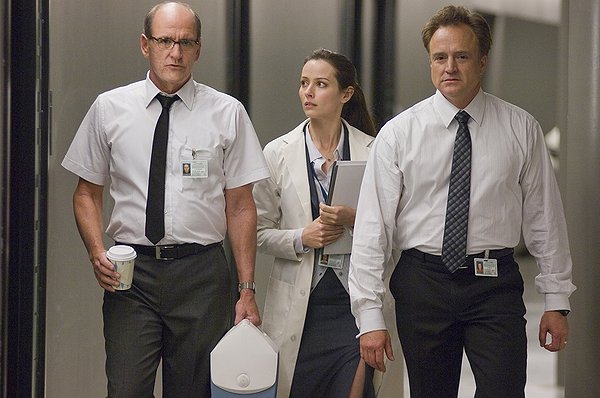
Two storylines converge in The Cabin In The Woods, augmented by myriad tales of times gone by.  The first storyline begins with the adroit pairing of Richard Jenkins as Sitterson and Bradley Whitford as Hadley.  Those two white shirted company men are Men In Black with pocket protectors instead of suit jackets.  Jenkins and Whitford are hilarious together, having a mundane domestic talk as they walk down a non-descript hallway to a lab with nary a test tube but screens and buttons and lots of unprofessional humor.  Each man’s last line in the film is just perfectly suited to his character.  And I won’t tell you what or why, you’ll just have to wait for it. 

It’s tough to tell who’s in charge of this massive federal expenditure, Whitford’s Hadley with his handsome sad sack face, or Jenkins’ Sitterson with his wry humor.  The delightful Amy Acker appears as a scientist named Lin, seemingly above the others, then joining in the totally unethical office pool.  Suffice to say her character from the show Angel receives a tip of the hat here as well.  Brian White looks just so trustworthy and above this behavior as Truman.  Alas, poor Truman. Oh, and there are mystery guests here as well.

Jenkins as Sitterman, Acker as Lin, Whitford as Hadley in the scientific complex.  (C) 2012 Lionsgate.
From the get-go Messrs. Whedon and Goddard (they wrote and produced together, and Mr. Goddard directed) want to let us in on the joke.  They tell us about the creepy guy at the decrepit gas station (played chillingly by Tim DeZarn), and show us the electronic web isolating the location — alas, poor bird.  We know we’ll see that web again.  Then there are the creepy 19th century toys in the inevitable basement of the cabin.  The movie could be split screen, with its two concurrent storylines coming together in surprising fashion.  The visuals are effective, building up the clues, creating not just a horror flick, but also science fiction with social commentary, its government scientists inhabiting an underground complex that’s like Buffy the Vampire Slayer’s “The Initiative” on steroids.
Holden the Egghead, Curt, Jules, and Marty (C) 2012 Lionsgate.

The movie is speeding along on a bumpy road in an open jeep with no shocks and no windows (OK, so they drove an RV, you know what I mean), and then the explanatory denouement goes on a bit too long.  Even once we know what’s been happening — but not what’s coming next — it’s still rollicking good fun, then slows down for too much “visual explanation” of everything you’ve ever wondered about — under your bed, in the closet, or what really lurks in the murky depths of the mountain lake.  I’m a fan of less is more.

My quibble is a spoiler, so skip this paragraph if you haven’t seen the movie yet.  To me, and no one knows this better than Messrs. Whedon and Goddard, things that go bump in the night are scarier than monsters we can see.  I’m sure it was fun, giving life to creatures of myth, fable, and their imaginations, and I can just see Whedon and Goddard fighting for their favorites.  Unfortunately, neither won, so the list was not winnowed.  Hence the overlong denouement.

Whedon and Goddard do not wimp out at the end.  Honest and fitting closure is provided by something akin to my memory of the moving logo of the very old black-and-white anthology television show Thriller (which predated Michael Jackson’s “Thriller” by several decades). 

Jesse Williams and Kristen Connolly as the smart guy and the good girl.  (C) 2012 Lionsgate.

Who needs to see The Cabin in the Woods?  People who liked the first couple seasons of Supernatural.  People who like Whedon’s wit and work (e.g., Buffy the Vampire Slayer, Angel, Firefly, Serenity, and Doctor Horrible’s Sing-Along Blog, among others).  People who like Drew Goddard’s work (e.g., Cloverfield, episodes of Buffy, Angel, Alias, and Lost as a writer, as well as all of those as co-producer).  Most importantly, people who like their frights seasoned with humor.  It’s date night, kids.  Go have fun.  Quibbles notwithstanding, I'm ready to go on this ride again.

~ Molly Matera, turning off the computer but not the light.  It’s dark out there.