Wednesday, July 18, 2012

The Elderly and Beautiful Adventurers


The Best Exotic Marigold Hotel is a surprising pleasure.  The main draw, of course, is its exemplary cast, who are introduced in their British habitats precisely in time to leave them.
Maggie Smith, Ronald Pickup, Bill Nighy, Penelope Wilton, Celia Imrie, and Judi Dench.  (c) 2011 Fox Searchlight.

-         Evelyn Greenslade — the delightfully subdued and spectacular Judi Dench — is recently widowed, having some issues with income and outsourced call centers as we all have.  While the remaining men in her life try to solve her problems as they see fit, she decides to give a whole new life a try.

-         Douglas and Jean Ainslie — Bill Nighy and Penelope Wilton — are retiring.  Well, he is.  She is a housewife with dreams of glory.  They’ve entrusted their retirement funds to their daughter, so presently cannot afford to live as Mrs. Ainslie would like to become accustomed.  Listen for her “turning left” dream.  They’re a mismatched pair, him self-effacing, self-sacrificing and kind; her, not so much.  Even when she’s not whining, we brace for a sour note.

-         Graham Dashwood, a dashing judge — the always welcome Tom Wilkinson — is suddenly of a mind to retire.  Get away from it all, and back to the land of his youth.  And possibly more than just the land and its light and color.

-         Mrs. Muriel Donnelly is retired, alone, and trapped in a wheelchair.  She is humorless, bigoted, and terrified, and as played by the irresistible Maggie Smith, still likeable.  She cannot get about without a new hip, the waiting list for which is too long in England.  She can get it more quickly and cheaply elsewhere….

-         Madge Hardcastle — the wittily impish Celia Imrie — is tired of being a live-in babysitter for her married daughter.  She wants life, and sex, and a new husband.  Her adolescent grandchildren understand her better than her own daughter, and off she goes.

-         Norman Cousins has still got it, he’s certain, he just needs to find someone who wants it.  Ronald Pickup makes this character a 20-something stuck in a 60-something’s body, but his forays into London nightlife are disheartening.  Norman needs a new audience for his old pick-up lines, so he joins these strangers awaiting a flight to a new home for “the elderly and beautiful,” the Best Exotic Marigold Hotel.

The journey is hard, the arrival disappointing, despite the optimism and warmth of their host, the proprietor of the hotel, Sonny Kapoor.  The sweet-faced and sincere Dev Patel plays Sonny with just a tad too much enthusiasm.  Sonny is in love with (but can’t say it) the lovely Sunaina (a delicately feisty young woman played by Tena Desae), who works for her brother Jay’s (Sid Makkar) call center. 
Evelyn (Judi Dench) and Madge (Celia Imrie) arrive at their new home.  (c) 2011 Fox Searchlight

Sonny Kapoor has a dream:  to resurrect his father’s dream of this ancient hotel in this rundown part of Jaipur, India.  His ruling mantra is “It’ll all work out in the end.  If it hasn’t, it is not yet the end.”  The Best Exotic Marigold Hotel is a disappointment to say the least.  The phones don’t work (although the computer connected to the internet does), and Madge’s room doesn’t even have a door — until she takes over Sonny’s room, so now he’s in a room without a door.  That’s Madge for you.  Madge and Norman look for love separately and keep bumping into each other.  Graham was brought up in India, so he’s looking for his rose-colored memories, perhaps, or perhaps something more.  Evelyn reinvents herself in this new land by getting her very first job — in Sunaina’s brother Jay’s call center of all places.  Douglas Ainslie is enthralled by his surroundings, the smiling faces, the food, the land, the buildings, the history.  Jean Ainslie won’t leave the hotel she hates.  Mrs. Donnelly gets her surgery despite her fears, and settles in, talking to the silent food server.  Real life interferes on occasion in the person of Sonny’s mother (Lillete Dubey), but not too much.  Even the traffic jams are entertaining.
Judi Dench, Tom Wilkinson, Bill Nighy.  (c) 2011 Fox Searchlight.

Does all this sound too good to be true?  Sure, but during the film no one cares. 

The actors are all very fine.  They take a lightweight script by Ol Parker (based on a novel by Deborah Moggach) and make it work. John Madden’s direction is swift without rushing.  The film pronounces its themes clearly:  Love is possible at any age, and retirement — not to mention life — will be what you make of it, money or no money.  And, of course, Sonny’s mantra. 

Every character (almost) has his or her arc of learning, growing, taking that first terrifying step into another life.  I won’t get specific here and produce spoilers.  Structurally I pronounce The Best Exotic Marigold Hotel sound — that is, the film, not the building!  If something’s amiss, it’s that the film is largely predictable, as is any story that strives for a happy ending.  This is a bit of summery fluff.  If you want no more than a sweet summer fling, sit back, relax, and enjoy the ride.
Evelyn reinvented.  (c) 2011 Fox Searchlight.

~ Molly Matera, signing off to look for a verandah and an exotic cocktail….

Thursday, July 5, 2012

Keeping the Blue Spruce Company

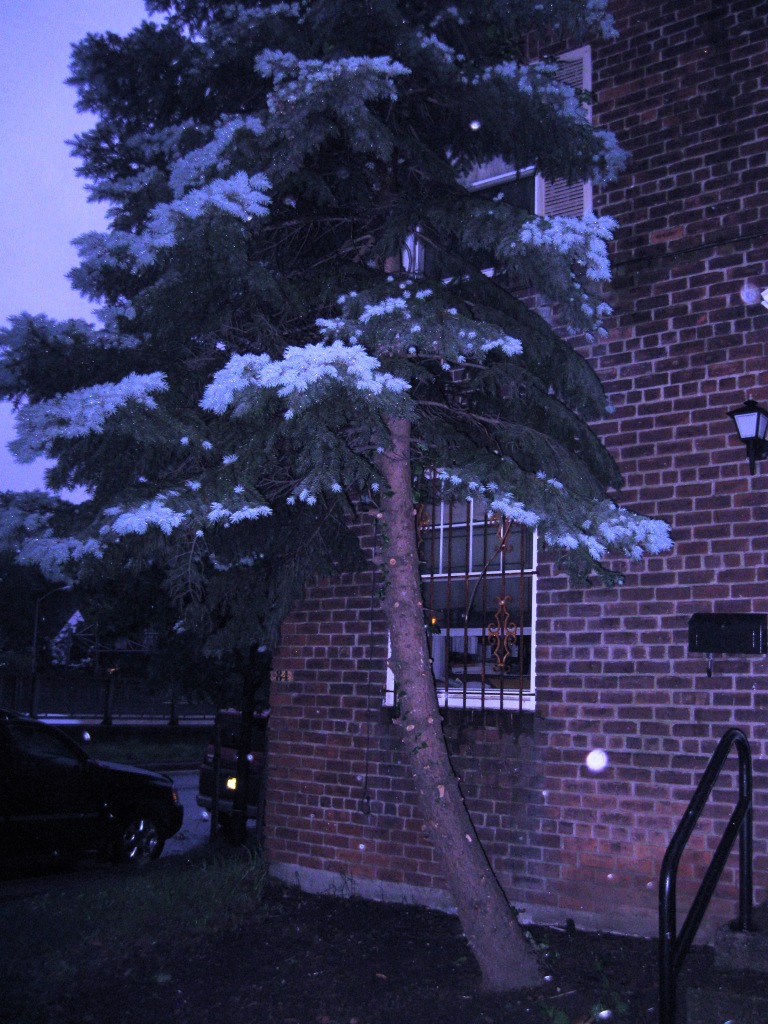
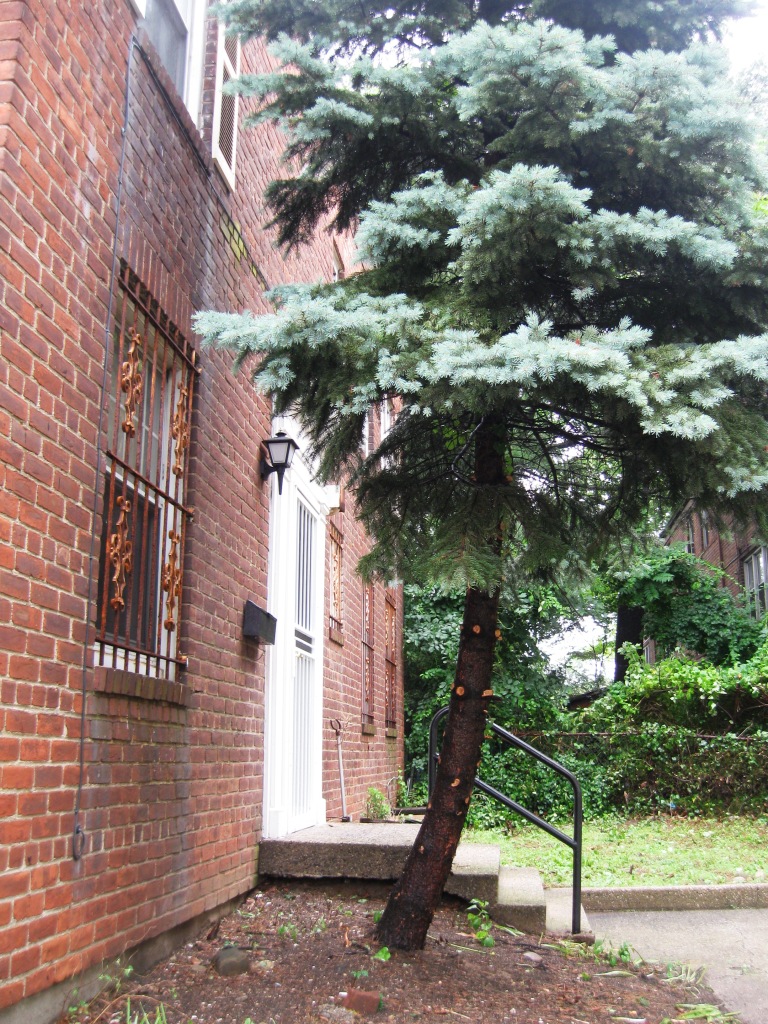
Now that my tree is bare, one of the interesting things to notice is how the tree trunk I could not see before has, over two decades, leaned outward, toward the southeast.  Interesting, but I'd still rather the tree was covered by its healthy branches.


My back garden is in dire need of weeding.  I charged the weed whacker yesterday, but that’s just what I use as a “lawn” trimmer, out front and back.  Today is not the day for weeding the back garden.  For today, I’ve done quite enough outdoor work on a 90-something-degree day.   

Yesterday I snipped some Swiss Chard and rinsed it in a little strainer.  I set it on the counter.  This morning the strainer and about 1/10 of the Swiss Chard leaves were on the floor.   What strange cats I have, eating all that Swiss Chard.  The three are lying around in today’s heat.  After working out front, my shorts were wet as well as dirty, so I just dropped them where I stood.  Chick promptly lay down on them and slept.

What I learned today:  Spruce roots are fairly shallow and spread wide.  That means it’s tough to find places where I can dig enough to plant two 6” pots of New Guinea impatiens.  Therefore, they’re staying in their pots.  The 3” pot I planted in the ground.  And I planted the somewhere-in-between pots of Bandana Lemon Zest Lantana.  The hydrangea is far enough off to dig a goodly hole in a spot that will get morning sun and later shade.  Small now, it’ll grow wide and tall in equal measure and give some shelter to my bedroom window.  My hydrangea out back are about 3 ½ feet wide and tall.
Stage 1: Hydrangea, New Guinea Impatiens, Lantana and little Artemesia

The little gray things are another story.  I see them all the time, and I like them, they’re visually interesting.  After searching on the internet for blue-gray frilly foliage, I am reasonably sure they’re artemesia.  I came back inside after planting in the noonday sun (I’m neither an Englishman nor a mad dog — I did, after all, come inside), I’m also reasonably sure I planted them too close together and too close to the front stoop. 
Stage 2: I don't like red mulch, so I went with dark stuff.  Unfortunately I just got 1 bag when I clearly need 3.

Next year….assuming as I am that the branches will not be growing back at all, and new growth will take years, next year I’ll get some pretty — and heavy — pots to ring around the tree with overflowing annuals.  The two hoses stretching to the front from out back may not be the best solution, but it’s all I’ve got.  Hey, maybe that slinky, creepy blue garden hose that’s curls up to a foot and then stretches out to 50…...ah, television commercials that look like the product can solve problems.  Will I never learn?

Back to those roots — and maybe next year I’ll do this — another option would be to set in a root barrier (might be a little corrugated metal fence, might be a ring of cobblestones set deep in the soil), since a little root-snipping and blocking wouldn’t hurt the tree.  It is, after all, over twenty years old.  The only thing that hurts it is when ignoramuses hack off branches.  They won’t grow back.  But there is new growth.  

~ Molly Matera, signing off to dream of a place where only people who love trees prune them.

My Big Blue Spruce


One recent Sunday, I sat in my back garden enjoying the peace of the sheltering trees and bushes and the view of birds and flowers.  Trucks on the highway can still be heard, but there’s a buffer zone, and a swooshy sound from the speeding vehicles passes between the buildings, keeping it far away.

Two squirrels sit calmly on one branch, while another goes up the juniper trunk.  It chases a fourth.  A red-breasted robin flaps in the birdbath and sings.  A bee lights on the pansies in the pot then swings by the multi-colored hydrangea.  Salmon-colored flowers bloom with the nasturtium leaves and zucchini flowers burst from beneath the broad leaves.

When I first moved here 20-odd years ago, it was February, cold and snowy.  The front door was reached by four steps, and the patchy lawn between it and the street was empty.  That first Christmas, I decided I’d have a live Christmas tree and plant it near the stoop.  I prepared ahead – Aunt Lois told me a trick my grandfather had taught her.  Dig the hole before frost, big enough to fit a rootball and more.  Add a little water to the bottom of the hole, then cover it with black plastic (since my grandfather was born in the 19th century, I’m guessing he said something like burlap, not plastic), then refill the plastic-covered hole with a mix of the original soil and a new topsoil mixed with peat moss.  Had this occurred 10 years later than it did, I’d have documented it with my digital camera; but alas, I had no such instrument back then. Only my memory serves.  For Christmas, I bought a four-foot tall blue spruce and kept it inside, its rootball in a large bucket, for the season.  After Christmas, and after some snow melted, I planted it out front, and much to everyone’s surprise, it took.  Over the years, it grew tall and wide and is now taller than the two-story building I live in.
Big Blue in January 2012 -- yes, ten minutes of snow melted ten minutes later.

Beyond its beauty, Big Blue (as I called it) offered a habitat to birds and shelter to me as well.  Its boughs covered part of my bedroom window, so people walking along the street couldn’t just see in – they’d have to get past the scratchy needles to do that.  More, Big Blue sheltered my front stoop, allowing packages to be delivered in safety without my taking off work to receive them.  I could tell any delivery service just to leave it on the stoop, Big Blue protects it all. 

Blue has been a part of my daily life for many years, a welcome home sign, and the landmark that my friends and family could use to differentiate my building from the others along my street.  Some weekends are chock-a-block full and busy, but I noticed a weed tree was growing strong between Blue and the building, so I resolved that I’d go in and cut that away the coming weekend.

That Tuesday, I came home in early dusk.  The black-eyed susans that had been clinging to the corner of the building were gone.  As were the hostas near the stoop.  As were Blue’s branches from the ground to six feet above.  My beautiful blue spruce had been butchered, the ground around it cleared of all perennials.  It was appalling.  Blue had been violently shaved, and I couldn’t help thinking of Eleanor Parker’s desperate whispered lines in the 1950 movie, Caged, after the other inmates had hacked her hair off:  “It’ll grow back.  It’ll grow back.”  The dirt around Blue was naked and lifeless, no longer covered by Blue’s protective needles.  My stoop and window were naked. 
twilight shock

One of the first things I ever transplanted was a hosta.  It’s still alive, out back.  Hostas are therefore, to me, almost impossible to kill, since I had no skill in transplanting.  Yet the hostas at the foot of my tree were gone.

The management office of the co-op closes at 5, but I wrote an email that evening complaining bitterly of the destructive act.  Home on Wednesday, I awaited a response.  The site manager and a minion came around with a camera.  I charged outside asking if they’d done it.  I was not calm.  They were.  After a few minutes she (the site manager) claimed it had been chopped up due to a security issue – the alleged security guard had allegedly seen a kid smoking pot behind my tree.  Obviously he was not well hidden, since the security guards never get out of their golf carts.  Poor kid, if he’d thought about it, there are plenty of places the security guards never notice where he could have smoked in peace.

Not that I believe that story.  If there had been a security issue and they didn’t inform me of it, surely that would be negligence.  If I was in danger because of my tree, surely they would have been concerned enough to send an email (they have two of my email addresses), a phone call (they have my numbers), or, easier still, put a note through the mail slot in my door, the way Metro Management generally communicates with the residents.  I received no warning of danger and no notification that either I should prune my tree or they would. 


What some incompetent fool with a power tool did to my tree was not pruning.  Metro Management does not hire people with any knowledge – the same unskilled labor paints porticoes and tromps through gardens with leaf blowers, and wreaks havoc on innocent plants with power saws. 


I wrote to every member of the Board of Directors of the co-op as well.  I have yet to receive a response.  To say nothing is to condone what was done.  It could have been a mistake, apologized for, and offers of new annuals to cover the naked soil could have been made.  But that didn’t happen.  In the weeks since, I’ve walked around Parkway Village, taking pleasure in people’s gardens and noting every tree or bush that could be seen as a security issue.  I won’t tell, though.  Metro Management might chop them down.

So, the upshot is this:  DO NOT EVER BUY INTO A CO-OP IN NEW YORK.  You’ll have no rights, merely responsibilities.  You will not be a homeowner.  Unskilled and ignorant laborers can destroy any landscaping you may choose to do with impunity.  Especially if the co-op board is foolhardy enough to hire Metro Management.

~ Molly Matera, signing off to go plant some impatiens around my poor tree, and a new hydrangea under my bare window.

Wednesday, June 27, 2012

Movies that may -- or may not -- be about or for or from Children


Moonrise Kingdom is a child's view of a memory of the 1960s. Not a 21st century child, mind you. A child of the mid-20th century. It is a totally false memory, of course, so I prefer to think Wes Anderson and Roman Coppola wrote Moonrise Kingdom as a fantasy, without the unicorns.

Moonrise Kingdom is a story of young love, broken hearts and lost dreams, which Mr. Anderson directed and produced.  In some ways, it’s very simple.  The girl — 12, knee socks and a short dress, eyeliner, she speaks little and has a pair of left-handed scissors.  The boy —  12,over-sized glasses, coonskin cap, corncob pipe:  Welcome to 1965.  Although adults may not believe it, these two fell in love, and that’s the most important thing in this movie.

 Moonrise Kingdom is sweetly nostalgic for a time that never was.  This story could not be told in the present tense, not in today’s uptight and frightened society.  So Mr. Anderson has brought himself and his characters back in time, and we enjoy them for an hour and a half.  Much more and we might not allow ourselves to suspend disbelief despite the engaging music, the cinematography with soft, natural tones by Robert D. Yeoman, and the interesting performances.  Besides, everyone smokes.

The set-up includes a house that looks like a lake house where a couple families might live in summers.  Apparently not – the Bishop family lives here all year round.  Their house is on one end of a small island off the New England coast, where people write and receive letters, listen to music and read to pass their summer days.  A scout camp is at the opposite end.  Across the cove there’s a bigger bit of civilization with a bigger scout camp, and a prosperous town, including a church where Benjamin Britten’s Noyes Fludde is playing, or has played, and may play again.  Mr. Britten’s music accompanies much of this film, starting with his “The Young Person’s Guide to the Orchestra” played on a small portable record player.   Then there’s some Hank Williams, then more Britten.  Music and orchestrations during the film are by Conrad Pope and they’re marvelous. In addition, original music by Alexandre Desplat is clever and fitting.
Suzy and Sam meet in the meadow.

From one end of the island comes orphan and foster child Sam (Jared Gilman), 12 years old and looking for love.  From the Bishop house there’s Suzy (Kara Hayward), misunderstood, fleeing (for “ten days or less” as she tells her little brother when she borrows his portable record player) an unhappy household where the mom calls the kids to meals with a bullhorn, when she’s not fooling around with the Island’s police officer.  These two star-crossed lovers will meet in the meadow, and the adventure begins, building up to an emotional crescendo in time for an infamous hurricane that floods coves and dams and knocks steeples off churches.

Bruce Willis is just marvelous as the sad-sack, good-hearted Captain Sharp who loves Mrs. Bishop, warmly played by Frances McDormand.  She and her husband Walt, oddly (and that’s not a bad word in this movie) played by Bill Murray, are both lawyers, and their idea of pillow talk is following up on each other’s court motions. On the other end of the island, Scout Master Ward is an 8th grade math teacher during school season, but considers the scouts his more important job.  Edward Norton plays the scout master with a sad fragility, gaining strength when needed — in some ways, that hurricane did people a lot of good.
Murray, Swinton, Willis, Norton, McDormand

Tilda Swinton makes a particularly odd appearance as a blue-clad “Social Services” unit.  There she was in her little cap, skirt suit, in an electric blue.  What was that about?  I didn’t particularly care, but the blue pulled focus. She served a purpose in the plot, but unlike everyone else in the film, she was merely odd, not interesting.

Wandering through the smoke, rain, and wind is Bob Balaban, master of ceremonies, narrator, historian.  I have no idea what’s fiction and what’s non-, since I tend to believe everything Balaban says.

Overall:  Moonrise Kingdom has great music, it’s a leisurely, odd, quirky little film.  It has a calming effect, and even the closing credits are sweet and cleverly done.  It’s a nice Saturday afternoon at the movies.  If your movie budget this summer is limited, Moonrise Kingdom will be just as undemandingly enjoyable and effective on the small screen.


Speaking of a child’s view, I saw the new Pixar film Brave last weekend.  It’s an absolute joy, funny, sweet, and, well, it’s Pixar…. from the music to the lyrical voices, to the gorgeous artwork, Brave just glows.  The loch looked like moving water, the horse’s fear made my heart pound, and the bears had full-blown personalities.  The people had as well!  Emma Thompson was Queen Elinor (well, her voice, but the facial expressions almost looked like her as well), Billy Connolly was a sweetheart of a dad as King Fergus, Julie Walters was very funny as the wood carving witch, and the delightful Kelly MacDonald wins everyone’s heart as the coming-of-age-child, Merida.  Animated or not, the acting was swell, the story was tight, and everyone should see this.  Well, maybe not kids under 5….it has some scary moments.

There was also an opening short called, appropriately, La Luna, which was short and sweet and clever and heart-warming.  Loved it – and look forward to more work from writer/director Enrico Casarosa.

~ Molly Matera, signing off to read a children’s book from the Sixties.

Saturday, June 23, 2012

As We Like It


The Public Theatre’s 50th season of Shakespeare in the Park has started off with a twang and a thrum and a heart-warming humdinger of a production of As You Like It.  Director Daniel Sullivan has taken the Forest of Arden and planted it in the American frontier leaning south.  A Lincoln Logs fort hides the Duke’s court up center, with a watchtower way up high.  A fellow in a vaguely Confederate uniform watches the audience amble in.  Another soldier joins him on a lower level.  Then four fabulous musicians, led by Tony Trischka, stroll on and joyously entertain us with bluegrass music written by Steve Martin (yes, walk-like-an-Egyptian Steve Martin).  Banjo, guitar, bass, and a fiddle, they picked and stroked and sang up a storm on a perfect evening in Central Park. 
Photo Credits Sara Krulwich/The New York Times

A sign hangs from a tree advertising a challenge to Charles the Wrestler, and the scene is set.  One by one we meet Orlando and Adam, Celia and Rosalind, Shakespeare’s usurper Duke Frederick, his entourage -- I can just type out the list of characters in As You Like It and say they were all well cast, loving their work and sharing it with us.  Sometimes when I see a Shakespeare play I have read multiple times and seen performed as many, something amazing happens, and I hear lines suddenly clarified, suddenly new, the suddenness magical.  This was one of those evenings in the theatre.

AYLI includes so many elements:  two instances of internecine quarreling — severe to the point of banishment and attempted murder — cross dressing, disguises, romance (primary, secondary, tertiary, quaternary), and a great deal of bawdy.  All these elements need to be blended together by a skilled director and, happily, Daniel Sullivan is a highly skilled, crafty, witty, and swell director. He tells the story of the play coherently, cohesively, and finds all the fun while retaining the verse and its rhythms.  Set designer John Lee Beatty integrated his clever set with Central Park’s trees so that it was tough to tell the landscape from the stage, while Jane Greenwood’s comfy period costumes made everyone easily shrug on their clothing to meet the day.

The opening scene of Shakespeare's AYLI is a weak one, providing exposition of Orlando’s family history and present estate.  Granted, in Shakespeare’s day people went to hear a play, not see it.  Nevertheless, it’s definitely telling instead of showing.  Showing comes soon enough, though, upon the entrance of Orlando’s elder brother Oliver.  The two men wrestle to the ground, Oliver emerging red-faced and furious, setting up a brother banished, and the possibility that Orlando’s decision to challenge Charles the Wrestler is not necessarily suicidal.  Knowing how to use one’s weight can be as important as having it.  This Orlando knows.

Most productions of AYLI begin to fail right there in the opening, with Orlando sounding petulant, hardly the stuff of a leading man.  Luckily the same words, under the more than capable guidance of Mr. Sullivan, sound different coming from David Furr’s Orlando, which is, bar none, the best Orlando I’ve ever seen.  Macintyre Dixon as Adam, the old manservant Oliver banishes along with his brother, is a good match for Furr, his new master.  And Omar Metwally does fine work as the elder brother with all the advantages, yet still feverish with jealousy of his younger brother’s natural graces.

Meanwhile, in the fort, Duke Frederick, the usurper of his brother Duke Senior, is an unstable fellow.  One moment he’s “hale fellow well met,” and the next he lashes out fiercely for no cause.  His exiled brother Duke Senior is of a much more even disposition, which the foolish might mistake for weakness.  The brother dukes are played by Andre Braugher, whose booming voice suits Shakespeare’s royalty and readily differentiates the dukes. He is kind and warm as Senior and changeable as Frederick.

Celia, daughter of the unstable Duke Frederick, is played with hearty relish by Renee Elise Goldsberry.  She is petite and pretty and powerful.  The connection between her and her cousin Rosalind, daughter of the exiled Duke Senior, is nearly palpable.  I’ve seen some good Celia’s, but never as clear a relationship as between these two women.  These cousins are like sisters, joking, arguing, teasing, loving, and defending one another against all comers – even if he’s a Duke.

The fights were all well staged by Rick Sordelet, performed well by Furr and Metwally and Brendan Averett, who played Charles the Wrestler. The important part of the wrestling scene, of course, is the magical moment when two sets of eyes meet, and Rosalind and Orlando are smitten, quite prepared to fall at one another’s feet.  Of course, neither can say so, and off we go.

Public Theatre Artistic Director Oskar Eustis’ Notes to the production state it clearly:  “You …do As You Like It when you’ve got a Rosalind.”  Has he got a Rosalind!  Lily Rabe is wondrous.  Articulate, witty, sharp, silly, she runs the gamut as Rosalind/Ganymede.  She was pitch perfect, gifting us with her beautiful use of verse, voice, heart and body.  Mischievously butch as she counterfeits a counterfeit of herself, witty beyond laughter in court or country.  Her Ganymede’s “You are not for all markets” admonition to Phoebe was fresh and new.

I can say with certainty that these were the best Rosalind-and-Celia and the best Rosalind-and-Orlando scenes I have ever seen.  Orlando’s not an easy role, so often appearing a doofus, but David Furr made him young and abused, young and brash, until he grew flowering into a courtier worthy of the daughter of a duke.  This was the first time I've really heard the scene between Orlando and Jaques, perhaps because it was the first time I believed Orlando was capable of the conversation. 

Stephen Spinella’s thrilling, ever looming, listening Jaques was drily funny and thoughtful and sad. The seven ages of man speech trotted along as Spinella simply told the story, without rushing, as if it had never been told before.  His opening lines just stop the show with laughter at his extraordinary tone.  He closes the first act with stillness.  I stood to stretch as others went off to the concession stand, and just watched him live those unscripted moments.  A wonderful performance.
Stephen Spinella as Jaques.  (Photo by Jennifer Broski)
Oliver Platt, not surprisingly, knows how to play the bawdy as Touchstone.  He is hilarious slapstick, rhythmic, scandalous. The pairing of Platt with Donna Lynne Champlin as Audrey, an earthy dancing fool, did not appear to be a courtly fellow taking advantage of a simple country wench.  Perhaps the opposite.  Lusty is as lusty does with those two.  I felt for poor Audrey’s wooer William (a single scene by a singular player, Brendan Titley, was just marvelous), but this Audrey and Touchstone belong together.

The foolish Silvius, in love with the shepherdess Phoebe (played by Susanna Flood, who was not quite in same part of the forest), was well done by Will Rogers with traditional oafishness that turns to wit when he learns a thing or two. 

Robert Joy’s Le Beau is charmingly foolish, torn yet loyal.  Among the banished duke’s followers is Amiens, played by the golden-voiced Jesse Lenat who leads the exiles in song.  All the crackerjack musicians (including Tashina Clarridge, Jordan Tice, Skip Ward, Anna Phyllis Smith, and Tony Trischka) in this production were splendid, as was the nifty choreography by Mimi Lieber.

In short, the Public Theatre's As You Like It is the best all around production of the play I've ever seen. Daniel Sullivan directed beautifully, Lily Rabe’s Rosalind and David Furr’s Orlando were stunningly played, Stephen Spinella is a better Jaques than we could dream, and Oliver Platt is the ultimate Touchstone. Go if you possibly can. Go wait on line beneath the shady trees of Central Park, or at the downtown theatre, or go join the Virtual Line at  http://shakespeareinthepark.org/tickets/virtual-ticketing/, but go see this well-nigh perfect production of As You Like It at the Delacorte Theatre before it closes much too soon at the end of June.

~ Molly Matera, signing off with a question:  Why isn’t this running two more weeks at the Delacorte?!

Saturday, June 16, 2012

9 to 5 + Trickster = Disappointing


This month the Women’s Project is putting on an experimental play — experimental in that it has multiple playwrights and directors creating it, rather like the large writing staffs of television sitcoms.  Not surprisingly, that’s what We Play for the Gods seemed like, except that it lacked a laugh track.  The laughs, chuckles, even giggles, were provided by a living audience.  However, in terms of the evening’s entertainment meeting the barest structural elements needed for a “play,” well: a beginning (none), middle (muddle), and end (still waiting). 
(C) 2012 Women's Project

The actors in We Play for the Gods are valiant creatures, so talented they make this play appear to work. Alas, it does not.  Is it a case of too many cooks?

As the audience enters the Cherry Lane Theatre, a woman sounding vaguely like a BBC Newscaster makes real and unreal announcements, asking (so discreetly) for donations for the Women’s Project in a soothing voice.  It’s rather difficult, therefore, to know when the play starts, since the same voice apparently proceeds as a radio broadcaster, awakening Simi, aptly described as a dysfunctional scientist.  Simi is well played with quiet pain and passion by Amber Gray.  A clip-clopping is heard — happily not a latecomer coming down the aisle but rather Annie Golden as Marla, office manager/administrative assistant/what have you for decades at the May Institute, “a world-renowned research institute dedicated entirely to the study of human behavior….” and so on.  Marla is experienced and practical, broken, used up.  Next in is Susan, a temp whom you just know will be arty. She’s terrified, oddly dressed for corporate America, and as we come to learn, a poet.  With an MFA, no less.  Irene Sofia Lucio plays this lost young woman beautifully, as Susan tries desperately to fit in, using her powerful “confident” voice that fools no one.  Lisa is the boss, perhaps once a scientist but now a brusque, tightly wound fund-raising executive with a repressive and probably vulgarian (male of course) boss above her.  She is bound to break into sharp shards before the evening is out, based upon this pitch perfect performance by Erika Rolfsrud.  And finally, the uninvited guest, a trickster “god” in blue, messing with everybody as if their real lives weren’t bad enough.  This mad woman, called the Provocatrix in the program, is played irreverently by Alexandra Henrikson.

Left to Right:  Erika Rolfsrud, Amber Gray, Alexandra Henrikson, Irene Sofia Lucio, and Annie Golden

These five dauntless women work very well together onstage and make us almost care. 

Was the point to show us that disparate desperate people are forced in our society (as if it’s different in any other) to work together in a place where nobody wins, nobody thrives, no one survives?  Or is it about “Trix,” the blue bitch who comes by to throw wrenches, high winds, and seagulls into the works to destroy what little these people have.

Only Susan, the frustrated poet — who seems to believe the Trickster may be her mischievous, miserably mean muse — seems to accomplish anything by the end of the play.  Simi appears to have gone quite over the edge, and Lisa and Marla will live on through Scotch. 

Yes, the Trickster god is not beneficent.  Nevertheless, just what was the point?  What we have here are four interesting characters in search of a story.  If those staff writers — seven playwrights, four directors, three producers — can find one, they may be able to write a play instead of a sitcom episode about working women, a derogatory phrase if ever this working woman has heard one. 

The Women's Project's latest project was disappointing.

~ Molly Matera, signing off to search the Internet for episodes of Murphy Brown.

Saturday, June 9, 2012

Fairy Tales: Another Retelling


The last fairy tale turned movie I saw did not go so well, but yet, with Chris Hemsworth and Charlize Theron in the mix, Snow White and the Huntsman (hereafter “SWATH”) was an obvious choice for the weekend movie.  First-time film director Rupert Sanders has put himself on my “worth seeing” list with this debut.
(C) 2012 Universal Pictures

SWATH was fun, gorgeous, with good direction and CGI and all things visual (as well it should be, at its cost), as well as some good writing by Evan Daugherty, John Lee Hancock, and Hossein Amini.  Not great writing, but a good story that moved along (except for those long shots of our heroes trekking through the hills), fleshed out some familiar characters in unfamiliar ways, snuck in a scintillating point of view, and finally brought it all to a quite satisfactory close.

This is not your grandmother’s Snow White, although it may be your great grandmother’s since it reverts, as modern interpretations tend to do (see Donna Jo Napoli’s novel Zel or Angela Carter’s collection The Bloody Chamber), back toward its grim forbears.  Fairy tales were not sweet, just as folklore is not.  Fables can be harsh.  Pre-Disneyfication, these stories were meant to instruct and terrify children in order to 1) keep them in line and 2) protect them.  The forest was indeed deep, dark, and dangerous, animals were fierce and lethal, and there are times we should not speak to strangers.

Charlize Theron as Queen Ravenna, Sam Spruell as her brother Finn (C) 2012 Universal Pictures.

Queen Ravenna is certainly not your grandmother’s Evil Queen.  Evil she is, but Ravenna is a feminist rewrite of the wicked stepmother, here appearing as an abused child revenging herself on the world, becoming predator instead of prey.  Queen Ravenna goes to any means to protect herself and her creepy brother Finn, and wreaks havoc while she’s at it.  Her history is effectively touched upon in the movie.  Perhaps that was the story Mr. Sanders really wanted to tell, since he cast someone who could really play it.  In the hands of Charlize Theron, Ravenna’s childhood fears follow her throughout life, as do her lessons learned:  If men find you beautiful, they may hurt you but they’ll keep you.  If they do not, you’re on your own.

The destructive reign of Queen Ravenna has corroded the land, the lakes, the hills, the mines.  The dark forest is truly frightening, as the woodlands before deforestation throughout Europe would have been.  From great hulking trunks spread branches and leaves that block the light; unruly tree roots and vines trip clumsy interlopers.  The unknown is on all sides, above and below, the better to fright you with….   

The forest created by director Sanders, production designer Dominic Watkins, art director David Warren, and cinematographer Greig Fraser, was terrifying, generating shivers and shrieks.  Even dismal forests don’t last forever, however, and the same team created a joyously colorful reward coming out of the woods.  The magic that follows Snow White is as bright as Ravenna’s is dark.  Some of the woodland creatures may have been a tad Disney-like, but the entry into this unexpected land was a breath-taking delight.  Except, perhaps, for the little fairies with their six-pack abs — I kept expecting tiny little sharp teeth to appear.  Be that as it may….. where there is light, there is shadow, and innocence has no defense against trickery.
Chris Hemsworth as the Huntsman, Kristen Stewart as Snow White

Costume design by Colleen Atwood was very fine — oh, those crowns, those capes.  Ravenna’s wardrobe is marvelous, the Huntsman could have been born and grown up in his clothing, the outfits worn by members of the pre-Ravenna court are gorgeous, opulent, healthy and happy.  Grown-up Snow White’s dress serves many purposes and looks terrific.  Ms. Atwood may be up for another Oscar.

Ravenna’s dark magic is visually stunning, her vampiric method of draining life and youth from young maidens repulsive.  Ravenna’s history is a horrific one.  Snow White’s travails, in comparison, are negligible.  What matters is what Ravenna inflicts on the entire kingdom, and every living thing above or below ground.  All bow to her fury and misery.  It is not only magic that created Ravenna.  She didn’t learn to be that woman overnight, nor on her own.

Charlize Theron makes the wicked queen hauntingly human despite her magicks, and often downright sympathetic.  When Ravenna shouts, it’s raw, angry, and powerful.  When Snow White shouts, her weak voice does not resonate, nor does it sound “naturalistic.” 

Kristen Stewart as Snow White was her usual tepid self.  She did as required by the intelligent script.  She has a nice face and a fan base, but while she did not detract from the film, neither did she add to it.  She's not totally incompetent, but she's....boring.  Sam Spruell playing Finn, Ravenna's sleazy, shudder-inducing brother, is not boring. Queen Ravenna, the Huntsman, William, the dwarfs, all had personal histories informing their characters.  So, presumably, had Snow White, but who could tell?

Sam Claflin as William
William, son of a Duke and presumed handsome prince prime for a rescue is the very attractive Sam Claflin, who gets the opportunity to play two sides of the fellow, and does a perfectly good job.  But hard as he may vie, the Huntsman, who does not even try, would get my vote.

SWATH brings the count to four characters in five films I’ve seen Chris Hemsworth play in the last three years.  When you’re hot….well, he is.  Hemsworth’s Huntsman is a brawling braggart, a drunkard, and a widower.  Like other characters in this story, the Huntsman has a history.  He makes us laugh, he makes us care.

The dwarfs are angry old men — mostly.  Fine actors play anti-Disney versions — no Sleepy, no Dopey, but all rather grumpy.  Look for CGI’ed versions of:  Ian McShane, Bob Hoskins, Ray Winstone, Nick Frost, Eddie Marsan, Toby Jones, Johnny Harris, and Brian Gleeson.  Yes, that’s eight.  There’s some singing, some dancing, some grousing and growling. 

The film has the requisite white horse to help the imprisoned princess escape the wicked queen, an unusual number of dwarfs, mysterious masked women, two guys trying not to vie for the princess’ affections, and a Transformation:  from a child running away to a young woman striding forward on a journey quest, picking up friends along the way.  For those looking for romance, the Snow White courted by princes in Disneyland is not here.  This Snow White, as created by Sanders and his three screenwriters, is a child forced into adulthood and responsibility for her kingdom and her people, not someone looking for a date.  When Snow White finally wakes up, she is focused, dresses like Joan of Arc, then does Joan one better.


At this point in the film, some people might ask questions like “But how…” or “but when….”  Don’t think about it.  Fantasies often cannot stand up to serious scrutiny.  Don't worry, be happy.

All in all, I found the film engaging from beginning to end, amusing at times, horrifying at others.  Disney’s sweet, but grim is more fun….

~ Molly Matera, signing off.  Time to dim the lights and re-read some tales from the Brothers Grimm….