Sunday, January 26, 2014

Will the Civil War Never End?


Downstairs at New York’s City Center, the Women’s Project Theater presents a play about the United States, human beings, divisions, and Pickett’s Charge.  Director Daniella Topol has guided her fine actors in an engaging and engrossing play about us, then and now.

Jessica Dickey's Row After Row is a treat, stimulating heart and mind, beautifully acted and directed.  The clever scenic design by Clint Ramos even provides a stimulating smell — wood, woodchips, and sawdust surround the warm set of an old wood and stone pub. 

Playwright Jessica Dickey has lived in Gettysburg, where history is not confined to the past.  Civil War re-enactors travel to each battlefield of the war and dress in Confederate and Union army regalia and weaponry as accurately as they can afford, and repeat battles.  At Gettysburg, the playwright participated herself in a re-enactment of Pickett’s Charge and found a story to express.  Thus Row After Row.

If you do not recall, Pickett’s Charge was the disastrous “hail Mary” play in the Battle of Gettysburg, in which Confederate soldiers marched then ran a mile through an open, undulating field, defenseless, toward their Union enemy. Not surprisingly, they were slaughtered by enemy cannon fire, a furious hail of bullets, and finally, when a decimated group made it to the Union line, bayonets and fists.  Over 2000 soldiers died that day, and well over half of them were Confederates.  Thousands more were wounded and captured.  It was devastating.  It still is.

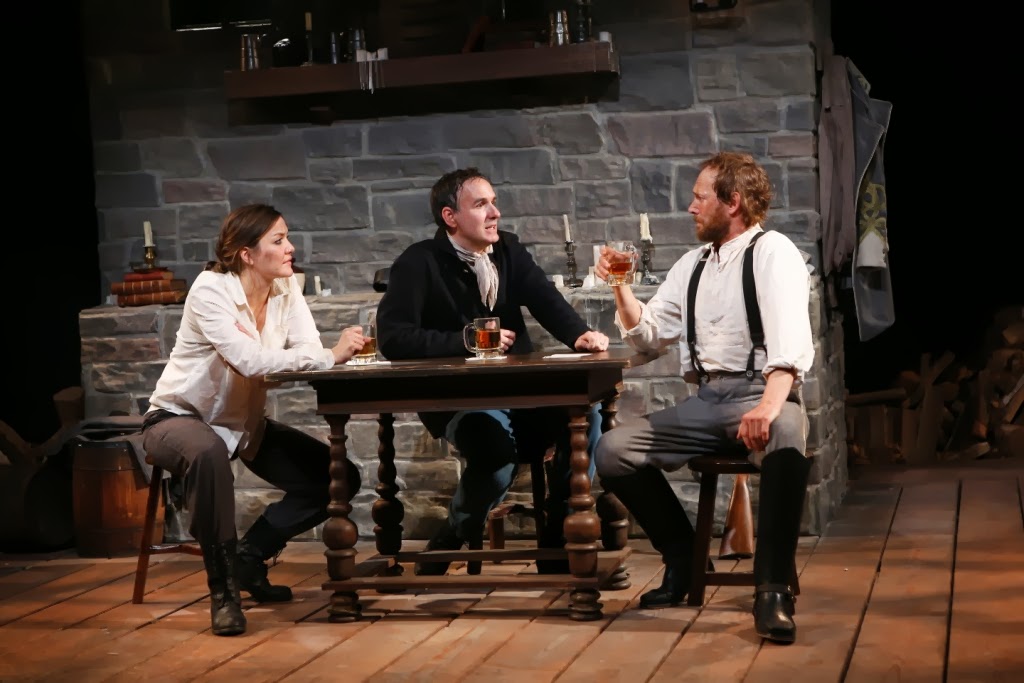
Rosie Benson as Leah, Erik Lochtefeld as Tom, and PJ Sosko as Cal.  Photo Credit:  Carol Rosegg
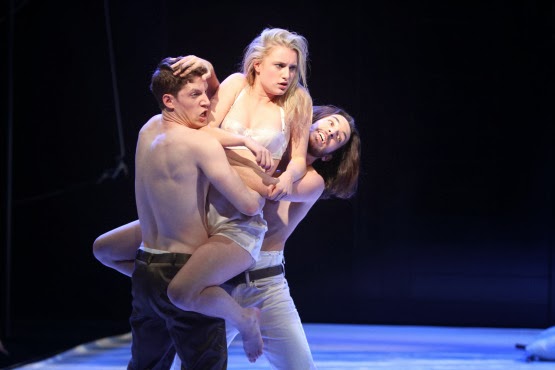
In Row After Row, the scene opens on three people — Lieutenant General James Longstreet watching the charge, a Union deserter, and a woman in the garb of a Confederate soldier.  Moments later, we see the woman sitting on a stool in a stone-walled pub, and the two men enter exuberantly.  They are re-enactors, the men having done this for 20 years, the woman a new participant.  The action of the play shifts back and forth between these three re-enactors in the present day and their counterparts during the real battle of 1863.  Lighting Designer Tyler Micoleau creates these time shifts subtly by a dimming, almost clouding of the lights when we revisit the sooty battlefield — the heat of a July day, men, horses, guns, and cannon all collaborating to kick up dust and smoke — then a slight bump to the soft but brighter light within the modern-day pub. 

The three actors are compelling in both eras.  Rosie Benton plays Leah in the present, a former modern dancer from New York, and a resident of Gettysburg in the past.  Leah simmers with anger and pain, yet an openness to new experiences and new people.  Benton is sharp, precise, and soft all at once, quite marvelous.  Erik Lochtefeld is Tom in the present, a schoolteacher, a re-enactor who chooses each year to play the Yankee deserter — an outsider who sues for peace in both eras.  Lochtelfeld’s skill and warmth bring us into his heart in both time periods.  PJ Sosko is Cal, who takes his re-enactments very seriously, and chooses to be General Longstreet.  Leah’s description of him as a “bona fide meathead” is probably the kindest epithet of the evening, yet he’s not all bad. He and Tom have been friends since 6th grade, but in recent years Cal has seen less and less of Tom and is almost as heartbroken as General Longstreet is upon watching his men charge to their pointless deaths.  Sosko grabs us ungently and brings us along as he tries to grasp the world around him.

Rosie Benson as the Woman in 1863.  Photo Credit:  Carol Rosegg.
Cal and Leah provoke one another once Leah sits at Tom and Cal’s traditional table.  Cal immediately dubs her a “farb” — a person who takes part in a re-enactment with less than authentic fabrics and costumes and weaponry.  A fight between the two men and another that includes the woman are brilliantly choreographed by J. David Brimmer, who more than met the challenge in the theatre’s close three-quarter staging.  

The Woman, Sosko as General Longstreet, and Lochtefeld as Union deserter in 1863.  Photo Credit:  Carol Rosegg.
Eventually we learn enough about these three people to hope they find their way, make the best choices, to do their part in making their lives, and our union, “more perfect.”  Like the Civil War, the past is not done with, and lives on in the present.

Cheers to all the cast and crew and creators of this fine piece of drama that includes some hearty laughs leavening the serious subject matter.  It was a satisfying evening at the theatre, but only runs to February 16th, so order tickets here:  http://wptheater.org/show/row-after-row/. 

~  Molly Matera, off to re-read some history that Jessica Dickey has clearly read already.

Saturday, January 18, 2014

EST presents a rooster, a hen, and some unpleasant not-quite-humans


Ensemble Studio Theatre’s production of Year of the Rooster by Eric Dufault is dully pretentious, superficially acted (with two exceptions), and altogether disappointing.  The play, in its current incarnation, was last done at EST just a few months ago, receiving enough good press to influence the theatre company to present it again.  Having sat through its tedious two hours, I do not understand what all the fuss was about, and John Giampietro’s tepid direction did nothing to pull the overlong piece out of the mire.

The main character, a pathetic little guy named Gil whose McDonald’s name tag reads “Girl,” is played cartoonishly by Thomas Lyons.  He is put upon by the various bullies in his life.  This “protagonist” is the same at the play’s end as at its beginning, and his cyclical journey was not in the slightest bit interesting or surprising.
 
Lyons, Bess, and Moreno in Year of the Rooster.  Photo Credit:  Russ Kuhner
The play opens with Dickie Timble (played with oozing slime by Denny Dale Bess), as a master of ceremonies at a cockfight, comparing that habitual torture to “culture” handed down from the Golden Age of Greece.  Dickie is a vulgar bully and an ass-grabbing back-slapping good old boy.  He is not an individual human being with realistically human traits.  We follow him to meet Gil behind the counter at the McDonalds.  Gil is the epitome of ineffectual, easily intimidated by his mean-spirited mother, Dickie, and the young woman who has just made manager at McDonald’s, Philipa.

Megan Tusing does remarkably good work with Philipa, a character full of stereotypical anger issues, then continues to stand out as the overfed McDonald’s hen with whom Gil wants his rooster to mate.  Said rooster is the most interesting creature in the play, the very angry and drug-abused cock Odysseus Rex, extremely well played by Bobby Moreno with birdlike twitches and physical and verbal passion.  Cockfighting is offensive yet the scene portraying it had the best staging of the play, choreographed by fight director Qui Nguyen.

It is a bit disturbing that the best drawn and acted characters in the play are not human. Gil’s mother Lou is a liar and a cheat, but Delphi Harrington is wasted on an outline of a caricature.  Everyone in this play is foul-mouthed and full of hate for everyone and everything around them, except for the hen.  When Gil makes it to the top of the pile of his insular cockfighting circle for a short while, he’s just as vicious and ugly as everyone who was cruel to him.  Because he’s as stupid as he is dull, he of course is not on top for long.
 
Apparently roosters, like cats, will attack their reflections
If that is the point of the play, please someone beg playwright Eric Dufault to revise it as a one-act.  In its present stage of “development,” it is two hours of torture. Mr. Dufault must go back to school.  Tossing in some cockfighting sports history of the Greeks merely implies he read some Cliff Notes about ancient Greece.  What he needs to do is finish reading Aristotle’s Poetics in order to understand what constitutes a play.  Year of the Rooster does not make the grade. 

~ Molly Matera, recommending you go see some other play in NYC.

Saturday, January 4, 2014

In Repertory: Twelfe Night and the Winter of Our Discontent

Shakespeare’s Globe is in town, and instead of performing one play at the Michael Schimmel Center for the Arts at Pace University downtown as they usually do, they brought two to perform in repertory for a few months on Broadway at the Belasco Theatre.  The Belasco is gorgeous, but with this company, it’s difficult to appreciate the beauties of the interior because as the audience enters the theatre, the actors are onstage dressing and being dressed.  Watching this fascinating process is riveting — observing the way period costumes are built, layer upon layer, onto the human body; some actors are sewn into their costumes; and seeing men turned into women. 

As in Shakespeare’s time, the female roles are not played by women, but rather by men.  Each man playing a female has a diverting way of walking, almost gliding across the stage, sometimes mincing, swinging the heavy skirts to their best advantage.  Watching them before the play even starts is mesmerizing.

Twelfe Night deserves its own glowing review.  Alas, I bubbled over with praise of it to friends and didn’t write down a word, so its mentions here will essentially be comparative.  I saw the plays a month apart — Twelfe Night (as named in the First Folio and printed in the program) on Friday the 6 December and, to start the new year off right, Richard III on Thursday the 2 January (yes, the night of the first snowstorm of 2014, nicknamed “Hercules”).  Perhaps we should have seen the Richard in this program first, so our expectations for the next play would not have been so high.  The Twelfe Night was deliriously funny, a pinnacle for all others to attempt.  As it was, the near perfect Twelfe Night left us with high expectations that were dashed the night the snow fell outside the performance of The Tragedie of King Richard the Third. 
 
Sebastian and Olivia, Orsino and Viola in Twelfe Night.  (Photo Credit: Joan Marcus)
What is it about Richard III?  I am often dissatisfied with productions of the play, no matter who excels in the leading role.  Is it just poorly written?  Well, with all due respect to the incomparable Bard, compared to other plays, it is, rather.  (He had to be careful, of course.  The late-arriving protagonist/hero of the play, Richmond, would be the great grandfather of Shakespeare’s Queen, so the War of the Roses had to end on a particularly redeeming note for the ancestors of the ruling monarch.)  This production from the Globe is well cast but that isn’t enough — especially not with someone as strong and magnetic as Mark Rylance prancing about the stage as Richard of Gloucester.
 
Rylance as Richard and Samuel Barnett as Queen Elizabeth
Once costumes are donned and the musicians applauded, Mark Rylance as Richard seduces us immediately.  Rylance found every hint of humor in the play, and made us as guilty as Richard by making us laugh with him throughout the evening.  The problem — and it may be the play as much as director Tim Carroll — is that the good actors working with Mr. Rylance fade in his aura, with two exceptions:  Samuel Barnett (a fine Viola in the Twelfe Night) as Queen Elizabeth (mother of the princes in the tower, wife of the sickly then late King Edward IV) gives as good as he… she… gets and is marvelous and powerful, every inch a queen; and the Buckingham as played by Angus Wright (last seen in one of the most delightful performances of Andrew Aguecheek I’ve ever had the pleasure to experience) could more than hold his own with Rylance. 


Often we see a star turn in a play like Richard III, and often we just think we got the second string touring cast in all but the lead role.  This time, though, we have very recent evidence of the finely honed skills of this company of players.  Which leads back to the play, which needed some judicious cutting, but perhaps not the cutting it did, in fact, receive.  More on that anon.
 
Joseph Timms as Lady Anne and Mark Rylance as King Richard III.  Photo Credit:  Joan Marcus.
Let’s look at the actors in this company.  Peter Hamilton Dyer’s Catesby was better than his often incomprehensible Feste, but Liam Brennan’s Clarence partook in one of the longest and dullest death scenes (and very poorly staged, Mr. Carroll) in Shakespeare despite his sexy turn as Orsino in Twelfe Night.  Paul Chahidi was a marvelous Maria in Twelfe Night, but his Hastings seemed stock and his Tyrrell seemed… well, rather mad.  As if he were speaking in tongues, his delivery rang through the theatre without cohering. 

Colin Hurley’s King Edward IV and his Lord Stanley were well defined and differentiated.  After his wild and woolly and hilarious Toby Belch in Twelfe Night, he was happily not a disappointment in Richard.

Joseph Timms was an unusually good Sebastian in the Twelfe Night. Generally a rather thankless role seemingly cast because of a resemblance to the Viola, his Sebastian had verve and vigor. Timms’ turn as Lady Anne (one of the most difficult roles in Shakespeare since her actions make no sense at all) in Richard III was interesting in large part due to his physical behavior.  That the character is ultimately unconvincing based on the famous wooing scene is the fault of the playwright more than the actor.

Kurt Egyiawan was not as interesting a Valentine in Twelfe Night as he was in his two roles in Richard III:  His Duchess of York (that is, King Richard’s mother) was basically cranky, but his physical work was good.  In the second half of the play he was Richmond, quite believable as the virtuous prince, a just man, a tad dull (Richmond always is), a fitting founder of the Tudor dynasty leading in a direct line to Shakespeare’s real life monarch, Elizabeth I.

Someone missing, you say?  Yes indeed.  There was one queen missing from this production of Richard III:  Margaret, termagant, widow of the dead Lancastrian King Henry VI who was ousted by the Yorkists (Richard’s family), and mother of the slain Prince Edward (who was the husband of Lady Anne, later Queen Anne – get it?).  This character should be the canker, the boil on Richard’s butt, an enraged victim of the Yorkists who teaches all others how to curse.  She was a major character in the Three Parts of Henry VI, and she’s fun.  She plays a major role in the conversation of the once powerful now powerless women of the play, leaving only the ineffective Queen Anne written in to join the bereft Queen Elizabeth, and the cranky Duchess of York to lament in Act IV scene iv, the traditional wailing women scene.  Perhaps the embarrassment of riches of too many queens in the script was seen as too confusing?  The long feud between the Lancastrians and the Yorkists certainly does not come as second nature, particularly to an American audience.  Nevertheless, Margaret is a vital part of the chemistry of the players.  Her absence contributed to the lopsidedness of the production, leaving out chunks of the politics, oversimplifying the changeable loyalties, essentially eliminating the history of each individual in the story, as if their own actions or inactions hadn’t brought them to this very place.  Richard III is the culmination of generations of internecine warfare; neither he nor his England sprang from nothing.  Ignoring what came before for the rest of the characters makes Richard III a showcase for Mr. Rylance instead of a play with intricate plotting and storylines.  What goes around comes around, that’s the moral of the story, but you won’t get it in this production.

Losing Margaret is short-sighted on the part of the producers and director.  I am far from a purist, but cutting Margaret’s character and its function diminishes the play — and even without her the production ran three hours!

Gentle reminder:  Twelfe Night was well nigh perfect.  Its subtitle is “or What You Will” and we will, we will.  Liam Brennan’s Orsino fell in love with the girl disguised as a boy played by an actor disguised as both, the wonderful Samuel Barnett.  Their chemistry was sparkling, ready to burst into flame.  The old gang at Olivia’s place were naughty and lusty, with superlative performances by Colin Hurley as Sir Toby Belch, Paul Chahidi as Maria, and Angus Wright as Sir Andrew Aguecheek.
 
Rylance as Olivia and Fry as Malvolio in Twelfe Night (Photo Credit:  Joan Marcus)
Mark Rylance proves he does not need to edit a play to make himself the star — his Olivia is timid, brittle, then giddy and lusty and wild, his powdered face malleable, his body alternating between stiff and yearning, girdled and rubbery.  His line readings will overpower my mind whenever I re-read the play.  He’s a comic genius with brilliant timing — which shows up in his Richard as well, of course.

The member of the company who appeared in Twelfe Night but not in Richard III is the estimable Stephen Fry, whose Malvolio was articulate, witty, arrogant, and deserved what he got — until he didn’t.  Suffice to say, Fry was an excellent Malvolio and I hope he returns to the New York stage soon.
 
Samuel Barnett as Viola and Mark Rylance as Olivia in Twelfe Night (Photo credit Joan Marcus)
In general this is a marvelous company.  The scenic and costume design by Jenny Tiramani merge into a whole that is magnificent.  The audience members on the stage may see a lot of backsides, but their proximity to the players makes them part of the experience, and the players’ connections to living audience is just thrilling to see.  Music by Claire van Kampen is period, fitting, and well played and well utilized in both productions.  Director Tim Carroll worked wonders with the great Twelfe Night but fell down on the job with Richard.  That said, I have no knowledge of the script he was handed, since no dramaturge is mentioned in the program. 

Editing Shakespeare isn’t easy, though often necessary.  The wrong bits were edited out of this Richard.  Thankfully the Twelfe Night was so extraordinary it entirely redeems the problems of the Richard.

~ Molly Matera, signing off and urging you to see at least one if not both of these plays in repertory.  (If just one, you know the Twelfe Night is the better!)
Monday, December 9, 2013

A Dream Opening for TFANA's New Home


All the superlatives have been used up on Julie Taymor’s various productions over the years, so I’ll try to refrain.  That’s not easy, however, in light of this scrumptious presentation of William Shakespeare’s A Midsummer Night’s Dream — a fitting inaugural production of the new permanent home of Theatre for a New Audience:  the Polonsky Shakespeare Center in Brooklyn.

A Midsummer Night’s Dream is a delectable feast for language lovers, comedy and romance lovers.  This production is imaginative, light, sprightly, clever, funny, well designed, well acted….superlatives rain down.

After the debacle that was Ms. Taymor’s film version of Shakespeare’s The Tempest, my faith is restored by this staging of Midsummer.  Here, Ms. Taymor uses a hodgepodge of technology and arts available to theatre and circus, and blends them to a euphoric wholeness that never overwhelms the words Shakespeare gave us (and the actors) in this beloved play. 

Once we’ve gasped at the beauty and cleverness of the active scenic design — very active — we are enthralled by Puck, in white face, chalky like a sloppy jester, played by the extraordinary Kathryn Hunter.  Hers is a highly intelligent, impish and athletic Puck, doing aerial acrobatics and leading all the players, human and fairy, between Athens and the magical wood “a league without the town.”

You may have heard that the stage is filled with children.  That’s true, playing the sprites and fairies of the forest, singing, swooping, creating the mist and the skies, almost flying.  These images are helped along by the organic choreography by Brian Brooks.  Musicians Jonathan Mastro and Wilson Torres carry the children and us to the fairyland to meet Titania, Oberon, Mustardseed and the rest on waves of music by Elliot Goldenthal. All the designers combined in this production created a wonderland for us, including Es Devlin (Scenic), Constance Hoffman (Costume), Donald Holder (Lighting), Matt Tierney (Sound), and Sven Ortel (Projection Design).

The stage, the balconies, the edges and tops and bottoms and sides are all well used — characters disappear into trap doors, up to the heavens, backward and forward, and the trap doors provide still more levels for the actors to play in.  From the lovers to the mechanicals, this ¾ stage and above production afforded space and angles and highs and lows.

Tina Benko as Titania
Tina Benko’s towering Titania (children playing fairies aids in this image) has ivory skin and a musical voice making for a sensual and funny and extremely pale embodiment of fair Titania. In stark contrast to Titania’s whiteness was the darker than deep brown of David Harewood’s Oberon, his magnificent voice commanding then cooing and wooing.  Shakespeare’s verse flows trippingly on the tongues of these two well-matched artists.

David Harewood as Oberon, Kathryn Hunter as Puck at right
Back in Athens, Egeus is well played by the always reliable TFANA stalwart, Robert Langdon Lloyd.  Okwui Okpokwasili and Roger Clark were well suited to each other and their roles as Hippolyta and Theseus.  The four lovers were quite delightful, passionate, lithe, limber, enjoying a fine pillow fight abetted by the fairies.  Those disguised children even play the magical forest, putting obstacles in the way of the benighted and bewitched lovers lost in the woods.  It was all very clever fun.  Good work by the mix-and-match lovers, Mandi Masden as Helena, LillyEnglert as Hermia, Zach Appelman as Demetrius, and Jake Horowitz as Lysander.

Zach Appelman as Demetrius, Lilly Englert as Hermia, and Jake Horowitz as Lysander
The Mechanicals are a motley crew, led by a charmingly gauche Joe Grifasi as Peter Quince; a haplessly huge Brendan Averett as Snug the Joiner, the frightened lion; a sweet-voiced Zachary Infante as Francis Flute and a femininely feisty Thisbe; William Youmans as Robin Starveling, an easily affronted Moonshine; Jacob Ming-Trent as Tom Snout, or The Wall; all mastered by the remarkable Max Casella as Nick Bottom, the (dream) weaver.  The edits in the script were made with a light precise touch, nothing was missed, least of all Philostrate’s prattling about the various offerings for entertainment at the Duke’s nuptials.  As played by Puck, who knows how to entertain a crowd, Philostrate passes by the hemming and hawing about what play was to be presented — we want Pyramus and Thisbe, and we are not disappointed.

The only flaw in the TFANA’s brand new Polonsky Shakespeare Center is that the central section of the orchestra is not adequately raked — from my second row seat, I could not see action just left of center especially when the actors were lying or rolling or otherwise on the ground, as fairies and imps and lovers are wont to be.  Bits in that spot garnered laughs, but not from me – and the fellow in front of me was not inordinately tall 

Midsummer Night’s and Bottom’s Dreams are many-leveled, quite literally, as Ms. Taymor likes to lift and swing her sets and her actors into the heavens and down to the ground (thanks and praises to Airealistic for the aerial design and flight), starting with Puck in the opening scene.  The stage starts off spare and grows to the limits of imagination and a midsummer night’s dream.  This production happily runs to January 12.  Start your new year off right!

~ Molly Matera, signing off to re-read the play, and check the savings account to see if she can afford to go again. 

Tuesday, December 3, 2013

2 Becketts in 2 Weeks


“Nothing to be done.” 

That’s the first line of Waiting for Godot, which Patrick Stewart accompanies with a shrug.  This combination becomes not just a running theme but a running gag.

Waiting for Godot is the other half of the two productions playing in repertory at the Cort Theatre, both starring those two Sirs, Patrick Stewart and Ian McKellen.  (The other half, Harold Pinter’s No Man’s Land, was reviewed here on November 10.)


Sir Patrick Stewart and Sir Ian McKellen as Vladimir and Estragon.  Photo Credit Joan Marcus
This new production of Waiting for Godot, with its “new” pronunciation (stress on first syllable GOD followed by a clipped long “o”) sounds right, looks right, feels right.  In fact, everything about this production directed by Sean Mathias is so right that I’m calling it the be all and end all of Godots.

The ruined set of rubble and broken boards, crumbling walls and one lone, bare tree is already more set than Samuel Beckett wrote.  Nevertheless, its decrepitude is as magnificent as the decadence of the old Palladium, assuring us that life was once lived here but now not so much.  Stephen Brimson Lewis’ design for this set and the utterly natural costumes are perfection.

In contrast to their roles in No Man’s Land, Patrick Stewart here is the exuberant one, and Ian McKellen the morose and unusually quiet one.
Patrick Stewart entered the stage as Vladimir, a.k.a. DiDi, seemingly delighted to be alive.  When Sir Ian climbed onto the stage from nowhere to appear as Estragon (GoGo), people in the audience annoyed me beyond measure by applauding just because the actors showed up.  It’s their job to show up.  Ian McKellen and Patrick Stewart and Shuler Hensley and Billy Crudup all did a good deal more than just their jobs.  They found a way to live in that dreadfully confusing, perversely funny world created by Samuel Beckett and made us love — or hate — them for a while.  Laughter assuages the pain of that reality.

Back to McKellen’s entrance — he climbs onto the stage from a ditch where he was beaten the night before.  Not for the first time.  DiDi’s insistent cheerfulness is apparently more than GoGo can bear past dusk and he goes off alone after their long wait.  Over and over.  And back they come, to wait for Godot.

Shuler Hensley as Ponzo and Billy Crudup as Lucky.  Photo Credit Joan Marcus.
One must wonder why anyone continues to force survival in this lifeless world.  Yet Act 2 shows a few buds on that bare tree.  So is Act I the winter and Act 2 the beginning of spring?  Early spring, cold, but budding.  GoGo & DiDi survive each day by each other’s company.  DiDi talks GoGo out of suicide by hanging in order to keep his company.  After all, if one helps the other to achieve such a final goal, the survivor will lack help to join him.  Hell, apparently, is not other people as Sartre told us in No Exit.  It’s loneliness.  Two people, three, four together can survive anything so long as they are not left alone.  They can and will come back every evening in hope and belief that the expected Godot will arrive.  While their hope is dashed at every dusk, they’ll do it again so long as there is more than one waiting.

To break up GoGo & DiDi’s day, Ponzo — interpreted as a good ol’ boy by Shuler Hensley with a southern snarl and frightening clown-like make-up by Tom Watson — does hog calls and leaves all the heavy work to a slavelike creature named Lucky.  Lucky, while not a pig despite Ponzo’s repeated calls, is barely identifiably human, as played with fragility by Billy Crudup.   His focus and concentration on whatever world Lucky lives in is remarkable to see.  These guys were having a fine time.

Once or twice a boy comes to see Estragon and Vladimir, professing not to recognize them at all and denying he was there the day before.  He tells them that their wait for Godot is over, because Godot is not coming that evening. Surely tomorrow. 

Estragon, Ponzo, and the boy appear to recall naught of the day before, while Vladimir is cursed with remembering it over and over.  Lucky — well, who can tell what Lucky remembers besides a long string of fabulousness.  Vladimir reveals to his fellows what has previously occurred, but it’s meaningless to them.  Is it Vladimir’s memory that gives him faith?

The Sirs' Curtain Call.  Photo Credit Matt Hennessey
I think we enjoy being mystified by the “meaning” of Waiting for Godot, which is revived quite regularly.  I think we long for interpretations that tease us and then allow us to stop thinking about it, interpretations that allow us to trust the director and actors to tell us, obliquely, what they think it’s about. I am happy to entrust the “Meaning” to this company.  Some forms of art should creep up on you while you’re not looking. 

Out thinking Beckett is not my line.  I can imagine Sam Beckett chuckling, nodding, perhaps saying, “Well that passed the time.”

 * * * * * * * * * *

Speaking of Samuel Beckett, we saw another one last week at the 59E59 Theaters – All That Fall.  This is one of Beckett’s radio plays, transported to the stage as a play within a play — sort of.  There’s no muss, no fuss, no extraneous set.  Just a room with old-fashioned microphones hanging from the ceiling, and half a dozen chairs lined up on either side of the stage, facing each other.  One set piece will be a car later.  This spare set design was by Cherry Truluck, with clear lighting by Phil Hewitt and apt sound by Paul Groothuis. 

The actors walk in and take their seats while some sound effects come into play.  These are the radio actors.  This concept was interesting to watch as actors played actors playing characters.  Odd, without a doubt, but interesting.  It was clear when an actor was the actor playing a character.  Sometimes the actors laughed silently when not “onstage” (but seated on the side).   The heart of this play is a riveting, sad and hilarious performance by Eileen Atkins as Mrs. Rooney, who is walking to the train station.  We see she drags a leg (and hear the radio sound effect), and watch as she meets neighbors on her journey to the station to meet her blind husband played by Michael Gambon.  Each of the neighbors with whom she chats, laughs, or disputes along the way has his own cross to bear, and each is vocalized by an actor playing an actor….you get the picture. 


Michael Gambon & Eileen Atkins in All That Fall.  Photo Credit Sara Krulwich
As No Man’s Land is Beckettian Pinter, so All That Fall is rather Pinteresque Beckett, with laughs at the human condition surprised by a devastating burst of sorrow.  Director Trevor Nunn kept it clean and simple, and every actor was on the mark.  Standouts were Trevor Cooper as Mr. Slocum, Catherine Cusack as Miss Fitt, and Ruairi Conaghan as Christy. 

Two PInters + Two Becketts = theatre that forces you to think, then forces you to admit it was pointless.  Nothing to be done…..

~ Molly Matera, signing off to re-read some Beckett….

Sunday, November 10, 2013

Two Pinter Plays in Two Weeks


Harold Pinter’s Betrayal has been revived on Broadway, the West End, or wherever else many times since its debut in 1978.  Not because it’s a great play, but because actors love the challenge of it.  Betrayal is an interesting character piece, a study of intertwined relationships, with a gimmick — a conceit, if you prefer — in which the playwright plays with our perception of time as he manipulates his characters back in time.

Its three characters live backward before us, so that we see (and the actors play) the end at the beginning all the way through, reverse chronologically, to the beginning at the end of 75 or so minutes.

Mike Nichols is a highly skilled director and the production presently playing to full houses at the Barrymore is polished from curtain rise on 1977 back to 1968, with sets by Ian Macneil sliding in and up and out and down, portraying places where these three characters live and love and hate. 

Pinter tells us in the very first scene everything that’s happened and that therefore we are going to see, but that doesn’t keep us from watching all the way through.  It’s about how, not what.  Each time something is revealed, we yearn to see what happened before that, and before that, and before….instead of next, next, next.  It’s a fascinating conceit and it does work.

While Rafe Spall may not yet be a star in the U.S., he will be.  His besotted Jerry is a delight, Jerry who is nothing special, whom one would pass by on the street, but who inspires love in the other characters.  Mr. Spall’s lanky form curls and slopes and leans into and away from his fellows.  It’s impossible not to watch him onstage, even when Daniel Craig is beside him. 

It is Jerry who is in most of the scenes, and even if he’s not present, the other characters are thinking about him, so we are as well.  The second scene of the play, between Jerry and Robert (Daniel Craig), is beautifully staged, with the long estranged friends starting on opposite sides of the room, crossing past each other’s territory, until the truth allows them to become comfortable with one another again, sitting together.  Gorgeous.  This immediately sets us up, as well, to not particularly like the woman who came between them, Emma.

Despite the fact that Robert admits to having “bashed” her once or twice, Emma (Rachel Weisz) seems always in control of the relationship between herself and Jerry.  Her only vulnerability shows when Jerry leaves for America and she breaks down in front of her husband, whom we’ve just learned knows about his wife and his best friend.

Robert likes to play squash with his male friends and go to the pub afterward, an afternoon and/or evening of all male companionship.  No women.  We can tell he’s a terror on the court and he has noticed that the men he knows or suspects are sleeping with his wife will no longer play squash with him.  He may not be Menelaus, but the savage sometimes rears its head beside that of this cerebral man.

Of the three characters, Jerry is most breakable, most childlike.  Robert has built up a hard shell, humorous when he oughtn’t be, seeming callous.  Daniel Craig makes it clear there’s much more going on than that. 

I was surprised to find Rachel Weisz, whom I quite like on film, to be the weakest link on stage.  Pinter pauses are one thing, but her side of the stage sometimes appeared, sounded, rather empty.

Stephen deRosa’s delightful turn as the waiter in the Italian restaurant is as polished as the three primary roles.

Pinter and the company stimulate our laughter at the vagaries and vanities of human nature.  An intellectual play, Betrayal is not quite great, but it’s more than clever.  It’s not easy to connect with these characters however similar their stories may be to some of ours.  Despite the tight and smart direction, despite the performances, nothing about this production engaged me.  The people did not engage me.  So for all its clever mind games, my heart was untouched.

The second Pinter play was one I’d never seen before and which, although in chronological time, was by far the more confusing of the two.

No Man’s Land is part of a double bill with Waiting for Godot — which I look forward to seeing in a couple weeks — with a highly anticipated cast:   Patrick Stewart and Ian McKellen supported more than ably by Billy Crudup and Shuler Hensley.

No Man’s Land, unlike Betrayal, is played in chronological time.  Note I did not say “real time,” because this earlier effort of Harold Pinter is wilder, more Beckettian.  Two men are onstage, and we know nothing about them except that one rarely speaks and the other rarely stops talking.  In the grandiloquent role of Spooner, Ian McKellen shines, glows, and takes flight.  As the quieter (for the first act) Patrick Stewart is fascinating in his stillness and sudden spurts of drunken energy.  Mr. Stewart’s character Hirst is falling down drunk but that does not deter him from heading for the drinks cabinet.  The babblefest continues until the entrance of Billy Crudup as Foster, the glibly dangerous younger man, self-appointed caretaker to Mr. Hirst along with Shuler Hensley.  This is typical Pinter, a couple of guys menacing by their very presence.  Foster holds in his violence with enormous effort, which does not lessen his ability to bully.  Shuler Hensley’s Briggs, the more obvious bully, barely speaks while holding himself at the ready.  Mr. Hensley is terribly still, emanating menace. 

The second act gets even more confusing with Hirst, now sober yet less than clear-headed, reminiscing with Spooner while addressing him by another name.  We start to wonder if these two men who’d appeared to be strangers the night before are now old … rivals?  Surely not friends.  None of the confusion is down to the direction by Sean Mathias, which was crisp and clear, rhythmically moving from quickly paced to leisurely.  It’s Pinter having fun with his audience again.

Ian McKellen and Patrick Stewart in No Man's Land.
The scenic and costume design by Stephen Brimson Lewis were perfect, lighting (Peter Kaczorowski), music and sound (Rob Milburn and Michael Bodeen) all contributed to the feelings of claustrophobia, menace, with a bit of “no way out” tossed in  No Man’s Land is beautifully put together.  We may not understand what happened in the second act any more than in the first, but with Pinter, we can always just raise our eyebrows and say, Oh, well, it’s Pinter.

~ Molly Matera, signing off as the fall season really kicks into gear.  So many plays, so little time….

Monday, October 21, 2013

The Donmar > St Ann’s Warehouse(s) all female production of Julius Caesar

"Girls! Girls! Girls!"  That’s what “theatrical” venues used to say about their female stars.  Phyllida Lloyd’s scintillating production of Julius Caesar is not titillating in the usual sense, and one would be foolish to call any of these women “girls.”  From London’s Donmar Warehouse to Brooklyn’s St. Ann’s Warehouse, this Julius Caesar is the opposite of traditional, since traditionally Shakespeare’s plays were performed by all male casts.  This production turns the tables.  The conceit for this is the setting of the play in a women’s prison.

Fair warning:  It’s not your standard entrance to the theatre space either. The crowd gathers in the aromatic coffee shop next door to pick up tickets, then masses in front of a loading dock’s corrugated metal door waiting to enter.  We wait a long time.  When we finally get in there, the audience is treated like visitors to a women’s prison, with lots of rules — though no pat-downs.

The masks of Julius Caesar

It’s past eight (which the officious email that had gone out to ticketholders said was curtain time — no latecomers allowed in!) when that big metal door rolls shut a second time, and a different door opens. Gray-clad women enter, and the action begins.  We are rapt, captive not just because the scary corrugated doors are noisily closed and guarded.  Physically, emotionally, intellectually, we are captivated.  Perhaps a little nervous.

The female prisoners are broken, shuffling creatures, weighed down by the incarceration and the hierarchy of the prison population.  They are mean to one another, small cruelties at first, ready to explode any moment.  The women show new life as they take on the characters of the play, changing no words to fit their gender (although, running a little over two hours, this script has been heavily and well edited).  It’s still Rome, they’re still “men.” Besides cutting scenes in their entirety, the 35 named characters of the play are whittled down to 20 as played by the company of 14 women.

The opening scene features women holding masks before their faces — the masks all the same photograph of Frances Barber as Julius Caesar.  The opening scene of the original script is accomplished very quickly without any of the text, just behavior and those creepy masks.  There are occasional insertions reminding us where we are.  Like those gray sweats, although the attempt to make all the women alike and equally downtrodden does not entirely succeed.  They are individuals, some willingly submissive, some frightened to be otherwise.  Each one comes to vibrant and sometimes violent life as citizens and senators of Rome.  The time is now, and the music is rock, driven by a bass guitar and drum set.  Harsh, loud, percussive.  
 
Slayers with bloody hands
Harriet Walter’s brittle Brutus is stuck in her head — his head? — overthinks, tries to be upright, and spells doom to his cause and comrades.  Frances Barber’s Julius Caesar is a bully (which makes even more sense at the play’s end, which I won’t spoil), easily scarier than any man I’ve seen in the role.  Jenny Jules’ Cassius is lean and hungry, spoiling for a fight.  Cush Jumbo is a smooth and moving Mark Antony, and Susan Brown a cunning and repressed Casca.
 
Harriet Walter as Brutus
Scenes are pared down to the bone, sharp, concise.  Things are not all orderly, there are shouts, a bloodied nose, a substitution of one prisoner for another to move the play forward to its inevitable end.  At one point a guard yells out “Meds!” offering a flash of One Flew Over the Cuckoo’s Nest.

I’ve seen quite a few productions of this play and directed a staged reading of it once, also with an all woman cast.  I heard then how different all those famous speeches sound in a woman’s voice, from a female state of mind, a woman’s heart.  At St. Ann’s Warehouse, the language is as fresh and new as the interpretations.  This Julius Caesar is totally different while equally tragic.  It is harsh and no one wins.

This is a limited run, only to November 3, yet it’s not sold out — I highly recommend you run to catch this excellent, rather thrilling production.

~ Molly Matera, signing off to re-read the play, hoping to hear those marvelous words and phrases in my head.